23:31



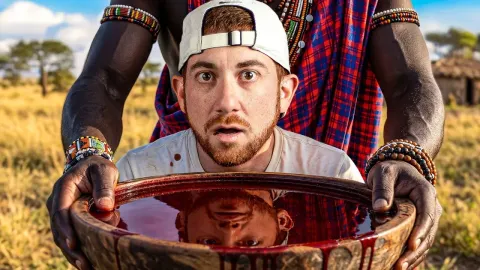
I'm here in Lagos, Nigeria, and I'm about to enter one of the craziest and most chaotic slums in the world! This is Makoko, where more than 300,000 people live in stilt homes above the world's most polluted water. You see, the color of the water is murky. This lagoon is their livelihood, but it's also their toilet, and their bathtub. Oh, man, I just saw a kid drink the water. It's so dangerous that I had to hire two policemen to protect me so I don't get robbed. But the biggest threat is the government, because it's only a matter of time until these people are forced out of their homes.
So, who lives here, and how long will they fight to stay? I'm about to spend a day in their world to find out. We're in the outskirts of Makoko right now. People banging on the car. Don't put the camera. He says "This is our community. You can't just come in here like that without, like, uh, permission basically." There's literally, like,20 people surrounding our car. I just told them now that I'm going to see, see the chief. They were like, "Oh, I should have told them that, I should have waited." Like, I've not seen you people before, and I don't know you people.
People are very, like, protective about their communities here. Are they guiding you there or they're like, still telling you to piss off? Yeah, they're guiding me there. No, they're guiding me. ___ He knows exactly where he's going. Here we go! Let the madness begin. Thank you for driving us.
I've heard so many things about this place. It's a whole community in here. It's crazy! And it's a big community! It is. Every time you hear the word "oyinbo", they're talking about you. The word "oyinbo"? Oyinbo, yeah. Means white guy. If you hear it, it's you. They're referring to me, or my Mate. One of us.
How are you, bro? Hi, how are you? Fine! This is crazy! I see, like, dozens of boats and big wooden sticks that they're using to push off the edge. If I fall in the water, it's game over! ___ There's no way you get fall in the water. If I fall in this water, leave, leave me there! This water, uh. yeah. Hey, man! How are you? My name is Drew. I'm Gabriel by the way. Good man, have fun. Nice to meet you, bro. Have you been here before? This is my first time.
Most Nigerians, it's their first time. That's exactly! It's a whole thing. What do you think so far? The environment is so hot. I think we're gonna come out very humbled by this experience. Yeah, very humbled. You can see, like, the only way to get from point A to point B is to take a boat. Like, you can't walk around because it's just water.
I guess you could swim. Would you swim in the water? No, never! That was a dead dog! These taxi drivers, they're just like, all day, just pumping the stick. Yeah, all day. Yes. Wow. I, I can't even gather my thoughts right now. This is really, really crazy! The water smells really, really bad. There's trash everywhere. But I'm seeing a lot of smiling faces, which is really nice. Like, through the cracks, everyone's waving and smiling.
You can see the little land that they do have is being used fully. So, here they're having a soccer game, and the kids are just kicking it around. But this is really one of the only plots of land that you'll see here. Everything else is just kind of makeshift, or it's just inside of their homes. I don't think I've ever seen so many kids in my life. Did you guys see the Afro-Japanese fusion -- restaurant over there? Makoko Waterfront. What?! Afro-Japanese fusion? I love it!
This lady's cooking a full meal here. She has the fire going. That is amazing! It's a full restaurant on the boat. What?! This lady has an entire shop here. That's really cool. Hey, how are you? Hello! They're all saying "oui, oui" like I'm French. It's amazing. There's kids everywhere. There's, like, kids' school boats going by. They're mostly under 10. A little boy said, "If you film me, I'll kill you!"
He ran away, he's over there. What's your name? Rose. Nice to meet you. How old are you? Can I ask you about your tribal marks? Who gave those to you? There's marks were being made when people were sick. They make a mark and then they put some medicine in it, and then it becomes a thing. This is not the only type of tribal mark. It's just in her particular case, this is what it is. Makoko started as a small fishing village in the 1800s, way before Lagos became the megacity it is today.
Over time, it grew into one of the largest informal settlements in West Africa. The residents are primarily from the Ogun tribe, whose ancestors are fishermen who migrated here in search of better waters. That was amazing! Fishing isn't just a livelihood in Makoko. It's a legacy passed down through generations. Nearly every family owns a canoe, whether it's for catching shrimp or traveling to school or the market. But life on the water presents a unique set of challenges. I'm meeting up with a chief's son named Sunday, who can tell us a little more about this place he calls home. What is the biggest challenge of, of living here?
I'll say living on water is part of our culture. Like, I can say we are very happy living in this place. And the challenges we're facing is just from the government. They want everybody to leave there corporate. Like, this is your home, so. Yeah, this is our home, but they want us to leave. They say Makoko is an eyesore. It's not good-looking. Another challenge, education. We run two schools in this place for free education, like, for the kids.
The first school in this place was given in 2009. Before that, there was nothing like education. So, the plan is just to make sure that the kids, they have standard and quality education so they go out to college, go to university, and then get a good job. The houses are everywhere. It's sprawling. If somebody wants to move here and, and make a house, anybody can just, like, build a, build a house? No, no. You can't just get it anywhere and build a house. That's why we have a chief. If you wanna build a house, you come to the chief, and tell the chief, "I need a place for my family to build a house."
Yeah, okay. Like, okay. Because this is where you should build your house. Is it dangerous here? No, it's not really safe if you come without us. And, you know, the guy that came to the car? So, I actually spoke to him Okay. on the phone. Yeah. So, you have to know someone. Yeah, you have to know someone. Exactly. Sunday sheds so much light on what it's actually like to live here. But there is a lot more to explore. For now, I'm ready to grab some lunch and see what kind of seafood these fishermen are bringing in. Wow, man! This is, this how they smoke the fish. Damn! See? That was amazing! It smells really good.
It's a smoky flavor. Hi! How are you? She says she's fine. Where do you get all the fish? Like, from which fishermen? A fisherman that normally sells fish to her. What's the best and the worst thing about living in Makoko? She says living on water is part of our culture. That whenever we're on, in Makoko, it makes our business so easy for us. It's easy to get the fish from the fishermen and easy for us to smoke it and to take it to the market. What's the worst part about living here?
Despite the fact that we are struggling hard to make a living, the government is still giving us problems. Government? Everybody blames the government? Yes, everybody. We are now choosing the fish for lunch, which looks amazing. They're gold. They're really smoky. This is awesome. The smoke is intense. That's our plate. Have you ever had fish like that, smoked like that? Um. I have, but never, like, right off the grill, so. ___ Drew, you are doing well in this smoke situation. I can't keep my eyes open!
I'm trying. That smoke is really intense. I can't imagine cooking the fish and standing there all day. I just came over here to gather my thoughts right now. I'm amazed. I'm. appreciative. I'm disgusted. I'm all words that you could think of. We are now going to go eat this fish, as I sit down and look at the water. So, they've made a makeshift table here with benches, and it smells really, really good. I've never had a circular fish before.
Just pick it up. Yeah. How do you do it? You just kind of, okay, and you open it? Yeah Like this. Bon appétit! Gotta be honest, that's pretty tasty. Perfectly smoked. no bones. Really tasty. This community is built on fishing. Fish is everything. So, it's really cool to try what, what they're known for. So, one fish is $6. You told me the average family earns $5 a day so they can't afford one fish. This is the most expensive fish? Yes. And do they sell it out of here, or do they just sell. They sell it outside. No, nobody buys this in this community.
They take it outside the community to sell. So, this fish is precious fish that comes from here, and they. sell it outside of the community? Yeah. And damn, it's tasty. How's that? So tasty. You like it? Love it! You're not talking over here, so your telling that you like it. Love it! Listen. so good. I have noticed a lot of the kids in their belly button it, like, goes out. Is that, like, what, what is that?
What? It's the way that they. They cut the umbilical cord? It's now common in Nigeria. And also it's kind of here, hereditary, so. if the mother has something big like that. Got it. You got it! They're picking up a dragonfly. It reminds me of Tawi-Tawi in the Philippines, but this one is definitely dirtier. It's, like, amazing here. So, we've made it to a little corner here where there's a family.
This is their house, selling the food. Hi, how are you? So, the whole family would sleep in this one room, right? Yes. Is this pretty much like a standard house here in Makoko? Yes, this house. most of the houses, the inside looks like this in Makoko. When it rains, does the water come through the roof or not? If the roof is not okay, then the water comes. But it's okay, there's no problem. For showers and this stuff, how does. We have to put a jerrycan. Like, the bath in the boat goes to where the water point is to fetch water and bring it to the house. So, everyone in the family has to do that?
Yes, every morning. Every. Every morning? Yeah, every morning. So, she has power, so she can charge her stuff? She actually have a small solar before which is no more working. Solar power. I think there's some kind of like peacefulness here because no one's on their phone all the time. Everyone's like in the community. I started using a smartphone. 2021. Twenty-one? Yes. That's when I started using smartphones. Really?! Probably opened up your, your eyes.
Yeah, yeah. It actually opened my eyes a lot. And it also helps me talk to the students about it and the internet. You know, one thing about people here is like they only work hard just to survive. Just, like, just put food on the table. Nothing else. They don't think about the future, savings. Nothing. Want to buy a car, want to build a house, if you want to do this? No. It's just day by day. As long as they have the food on the table, they're fine. So, the bathroom here is a curtain, and literally, you go inside and this is the bathroom.
They actually cut it to be kind of a toilet. But once again, there are people swimming in this water, they're drinking in this water. And. So, we now need to get back on the boat. But there's a bunch of boats in the way, so we have to make room. This is just a daily life situation here in Makoko. My mic just got stuck as he came on the boat. Onto the top of the gun. There's the mic, bro. ___ Correct. Mic check. The gun came and, like, hit me in the throat.
The gun was, it was here. That's how it got the mic. What do you think about Makoko? -- First time? So hot. I mean, the environment is not good to live. Well, we're living here. My house is here. This is where I stay. And we've been reaching out to the government to do it. Can we leave it alone? No. But for you to say it's not good for human beings, you see, you see they fall inside this water.
You swim in water, right? This water, I'm telling you, me, I will swim in this water and nothing will happen to me. The government have to help sort things. That's it. Yeah, yeah. They need to help. This place can be turned and can be better. We cannot do it alone. We don't have the money. This kind of environment -- I've not seen before. Whenever I pass Third Mainland Bridge, I only see buildings here. But I don't know it's something like this.
Sorry. I, I'm telling you, there are some people here that have been living here for more than 10 years. I can tell you, they never set their leg, their foot on the land. The only people I see they go to the land almost every day are the fishermen because they have to take their fish out to sell. On one hand, I agree with my bodyguard that the living conditions in Makoko are extremely difficult. But I also sympathize with Sunday that real people live here and their stories deserve respect. But no matter what, it's clear that this community needs serious support from the government.
Nigeria is the sixth most populated country on earth, and Lagos alone has 25 million people. So, as the city keeps growing, the pressure on slums like Makoko will only get worse. We've made it to the clinic here in Makoko. You can see there are four beds for patients who might be sick. Is healthcare, like, an issue? Are a lot of people getting sick here? There's nobody here. So, the only time you get to see people here is during mosquito season.
What about, like, other sicknesses? Like. Other sicknesses, like typhoid. Most sickness you get to see people have in this place, typhoid and malaria. I'm amazed to learn that people don't get sick from the water. Like, we're used to it. It's really sad to see the situation here for a hospital. I can't imagine getting sick and coming here. I'm learning that you guys are, like, your health is, is fine. A lot of people will probably think that it's unsanitary. That's a lie.
Yeah. We're fine. When it comes to health, like, we're fine. The only thing that is affecting us is government trying to send us away from this place. Is it possible to catch a live fish. from the water and put it on a dry land to survive? Even if you take them from this place, go put them in a beautiful house on their island, they won't be able to stay like they want to stay in this place. People here, their life they're living is different life in that life, you don't just consider it the one you're living outside there, it's different.
Have you ever had, like, maybe, I don't know, a conversation with any of those councils to be like, "Okay, we don't want to go to land, but maybe this place can be cleaned up." And have they ever put in any effort towards, like, meeting those goals? Like, you have a lawyer now. We go there, we sit down with them, like, many times to compromise with them, talk to them, "Okay, this is what we want." But they just want to send people out of in Nigeria. Now, you know, this business is going around in Nigeria now, real estate. Every small part of the water, they want to sandfill it and sell it.
I think it's important to listen to people. Earlier, when they were talking on the boat, I felt like both of them had points. I understood where the policeman was coming from in that. Of course, it's not sanitary in a way. But that said, that doesn't mean this is not a lifestyle that somebody's living and enjoying and growing up in and being happy with and content with. You know, like, I mean, look at them. You speak to everyone. Everyone is like, "I love it here." It's ha, it's, you know, everyone's happy.
We can meet somewhere in the middle. We can clean it up. We can make it feasible for other people as well. It's not just government interests all the time. Makoko's backstory is even more devastating. In 2012, the Lagos government gave residents 72 hours' notice before demolishing the waterfront. Nearly 3,000 people lost their homes, many without a plan to relocate. Since then, support has barely trickled in. There is no sanitation system, and diseases like malaria spread rapidly.
People are surviving, but they're doing it without any help. If the government and the community work together, then real change could actually happen. So, in an effort to meet more residents and hear their stories, I'm hopping back on the boat to see where the water will take me. I just got on the boat alone with Friday. What's up, Friday? Just me and Friday. Going to cruise around, see what we can discover.
I like to be on my own sometimes. Just kind of see how the experience differs. If it's just me, no policemen, no security guards, nobody else. Hi! How are you? Fine. The smell of this water is out of this world. I can't even begin to describe this smell. It's rancid. It's sticky. It's.
Absolutely crazy that people are living down here. Could see if the water raised just one meter, then this entire community would be gone. It would be flooded. You enjoy living here? Yeah, I enjoy, I enjoy myself. How much money do you make in one day? Just 1,500. Is it difficult to, to row the boat, no? It's difficult? No. You're strong, man. Yeah. I'm strong, myself! Yeah. How old are you? I'm. 20. years old. What's the best and the worst thing about living here?
I don't even know. I don't even know, sir. But I like this place. Look in front of us. I don't know how we're gonna get through this crack. The boat just bumps left and right. A road block! ___ Hi! Oh, he just drank the water. Oh, man! I just saw the kid drink the water. He jumped in and he just took a big sip of it. Watch out! Oh! The splash! You know, coming here to Makoko, it really humanizes you.
It really makes you appreciate where you come from. Because there's so many people around the world living in situations like this. They don't even have access to running water, electricity, even phones, basic sanitation, education. These are gifts that we all have in the western world. We are cruising down the highway. This is the main highway here in town. I imagine in dark time, it's pitch black outside because there's not much electricity.
This dude's just selling all kinds of shirts. Wow! It's really cool. When I look inside all the houses, I see a woman sewing. I see them, them cooking. There's a guy building nets for the fishermen. I mean, these people are just hustling like any other community. They're stacking bricks over there. I mean, these people are definitely busy. They're not just sitting around all day. They're doing stuff. As we drift along, Friday suggests we check out a building that means a lot to him.
The local orphanage. We have arrived. Thank you. This is your house? How many people live here? Like 10, 20 people? More. More? Yes. Thirty? Yes. This is your house. Yes. Come in, come in. These don't look like they're being used. He actually sleeps here. No. There's no pillows and no sheets? They just sleep on the bed? No, no blankets. They just sleep on the bed? Yeah. So, this is male room while the other one is the female room.
Got it. I said, he was very young when he was being found on the road, because we don't where he was going and we don't know where he is from. So, they saw him on the, in the market crying and they just yes. They took him home to come and give to the chief of the community, that we saw this boy in the market somewhere. Really? Yes. So, then they gave him a room here to be living. Is that a normal situation here? That happens with many people? Yeah. But that's nice that he has a home and he has people, you know, a place to sleep. So, the, the people that sleep here,
they're like his brothers and sisters? Yeah, they are like brother, treated like his brother and sister, like, and, and biological, whereas they are not. But they treat themselves equal. Do you remember when you were really young, like three, four, five? Do you remember what it felt like to be here without parents? He says, "I was went from the beginning, from a initially when they got lost." So, that what to think tohis parents, but nowhere to be found. So, until he get to the Chief, Chief's place, when they brought him there to the Chief.
So, they treat him like the biological son. Wow. He's a very powerful man. I wasn't expecting to be so touched by the spirit of this orphanage. Nigeria has one of the fastest growing populations on the planet with an average of 4.9 births per woman. And with so many kids growing up without parents, this place is full of hope. I still haven't made it yet to the local bar, and I'm dying to see where people hang out after a long day of fishing. So, Aisha and I are on our way.
How are you liking Nigeria so far? Uh. to be honest, I like places that make you think. And this is one of them. Yeah, this is one of them. It really is. What are your thoughts so far? Humbling, like I told you it would be. I've made so many, like, conspiracy theories. So many little connections with, like, not understanding that some people are okay living like this. They seem to be okay. Yeah, in there. It's just life. Look, kids swimming in the water. Are you okay? You're holding on like your sit.
I am, for dear life! Because I told you, if I fall, leave me in there. We are, we. we're tilted a little bit. She's like. What would you actually do? I would stay in there. I'm not coming home. So, Nigeria is the most populous country in Africa. That's bizarre. It is. Even everywhere else in the world, when you find, like, a huge population of Black people, almost always they're Nigerian. ___ Like, if you go to a country and you don't see any Nigerians, there's nothing to be found in that country! No money, it's empty. ___ What does it mean to you to be Nigerian?
We don't have the best political systems. We don't have the best government or whatever. It's literally patriotism over, like, little things that make this place unique. Wherever you kind of place a Nigerian, they'll find a way to grow. Like I said, the resilience, which is why, you know, we make a certain type of music, you know, film and cinema. Your impact on global culture is huge. It's huge! It's bigger than any other country. I would say me being Nigerian is being resilient.
Coming from the north, in what ways do you feel culture shocked in Lagos? Of course. The language here and there, and then now I'm speaking more Pidgin than I've ever spoken. Today, I'm spoking what they do. So, how do you say, like, "Hey, what's up? My name is Drew" in Pidgin? You say, "How far now." "How far now?" That's a greeting. Like, how you doing now? Yes. My answer, if you ask me "How far now?", I'll tell you "I dey."
How you say your name? "My name na Drew." See? How far now? I dey. My name na Drew. White boy. Classic white boy in Africa. Oyinbo! Oyinbooo! I mean, I, literally everyone is screaming it. I don't know if you're let, you're hearing it. I've been all. It's kind of funny. This is what a traffic jam looks like in Makoko. All the boats, they have to make room one after another.
Hey Friday, how old were you when you started driving the boats? Like this one, like this kid right here. He said seven or ten. Seven or ten? Jesus Christ! It just comes out of nowhere. I've already banged my head on several boats. It just comes out of nowhere. That was a lot of fun, seriously. I'm sorry. I'm so sorry. You almost fell in the water. Listen, I would have just gone back. She's cracking up at you. I was not expecting there to be a, a pub here.
We're in the pub. Nice to meet you. Pretty cool, huh? Happy hour. Happy hour! Did you tell your parents that you're coming here? Yeah. And what was their reaction? My mom didn't care. She was excited that you guys would get to see Kano. My dad's like, "Why Makoko?!" He's like, "They want to see the slums." But like, for me, it's interesting.
I want to go and see. But it's like a whole life here. What's your name? Jacob. Nice to meet you. Do you understand that? No, no. Nothing? Nothing. I've never heard of this language. Really?! We have so many languages in this country. So many. Hundreds. You know. Five hundred languages. Really? Yeah. Cheers, bro! Cheers, man! Oh, he's made his day with that beer.
He really made his day. Your whole life's here in Makoko? Do you like it? What's your job? Fisherman. Fisherman? You're a fisherman? Yes. The difference in your English when you speak to me versus a, a native, it's completely different. You just, he was like, "I don't understand anything." I think I got like 20% of what he just said. I'm speaking Pidgin. That's why. But my Pidgin is very poor, so I feel like you can understand.
I'ts not poor. What I say. This guy's asking her about her nose ring. What, what did he say? He says he wants one, but he doesn't want to be called a hoe. Yes. ___ A hoe? Is that really what he said? He said when he wears this one that he has, which is a magnet, people call him a hoe. So, if he wears this one, it's gonna be worse. My name? My name is Drew. What's your name? Luis. Luis? Angel. Hey, bro. No, no, no, no. Sit. Sit, sit, sit. Life here, in living, work we do. is marine work.
Are you a fisherman? I'm personnel. Navy? Yup. Oh, respect! I wouldn't want to mess with you, man. Yes, sir. So. why this community here? No government workers. All we do is river, like business center. What are some of the struggles that you have living here? Everybody here very poor. No rich money! Poor. But people seem happy. They seem, they seem happy. But a half bread is better than none. We are very poor.
No money, nothing. We always struggle. Hustling. Everybody hustling. to, to, to get a daily bread. Yeah. Yeah, hustlin. Nice to meet you. Thank you, man. My bottle is empty. Nice handshake. Nice firm grip. Can I hold you? Can I? Can you what? Can you hear me? Can I? It's not hurting me. My friend, my friend, you cannot. I gotta admit, people are friendly here.
They're very friendly. Sitting outside the bar here, having a little moment to myself. It's incredibly sad how these people are living. And I mean, this water is incredibly contaminated, and they have to live in it, and they have to bathe in it, and they have to be in it. You know, our local friend Sunday keeps saying that they don't get sick, they don't have any illnesses. which I find hard to believe. But all that being said, this is very much a community. There are people hanging out here, spending time with their family, kicking soccer balls. Everyone's smiling. It's very poor but that doesn't mean that they're not enjoying their lives. And I have seen a lot of really pleasant things here.
I love how the women are just going by, selling things on the boats, cooking fish. It really is just a way of life. And as Sunday keeps saying, they need the water. They live on the water. They'll do anything to be on the water. He made an analogy. He said, "You can't take a fish and put it on land, it won't survive." And that's what he's saying about this community. They have to be on the water. Everything's on the water. I'm feeling grateful to everyone I met today in Makoko, who so kindly took me around their community. With the right support, they can show the world what Nigeria's brilliance is really like.
Thank you guys so much for watching. It means the world to me that you're here to learn about the world and I'll see you guys in the next video.