4:27


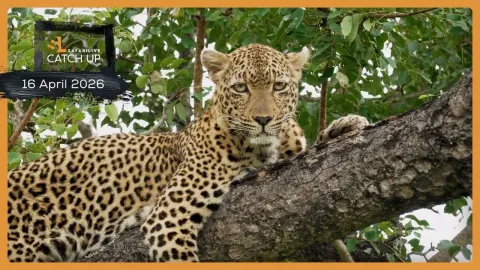
Welcome to your daily catch-up, your look back on the past incredible day out on Safari. From Rulani striking the perfect pose to the topi boys in full-blown battle, the weather not quite playing along, but that didn't hold us back. We even had super cute close-ups of a baby rhino and some thrilling wild dog adventures. Today had it all. Stay with us. I will Louise has started my drive on great days, great note.
I think to me this is one of the very best start of a drive. So many calves in this particular group of ellies. I've counted about five of them. You notice this one cow there at the left task look to be not straight. That will happen once in a while. And more often than not, that's always for genetical reasons. See how tall the red oat grass is compared to the normal height of elephants. Yesterday during the sunset, I think my alarm drive I was talking about oat grass. As much as it's pretty, you know, nutritious, many animals, and especially
elephants, will avoid it. So if you look carefully here, they're giving it a huge miss. And I'm very convinced these ellies are headed to the marsh area. Wow, look at that flock of ostriches. Oh. They probably We've counted more than 30 individuals here. Look at them. And this it's one of the highest flock of ostriches I've ever seen here in the Mara. And most of these are young ones.
You could see adults two, and one male and one female far off. Slightly more to the left of them. We'll show you in a bit, but look at that. How many are they? We've counted more than 30 individuals here. So most likely these all these actually from the same clutch. But definitely from different females. And in Kenya, we have two species of the common ostrich. We have the common ostrich, which is one that we're looking at. And there's also another one called the Somali ostrich, which is more confined to the northern part of Kenya and close to Somalia and Ethiopia.
Look at that. There's so many. I just love those colors in the background popping up. Just taking all the sounds, the water moving and the trees brushing, the birds chirping. It's quite a hub of activity here. Now, oxpeckers are super loud and vocal this morning. I think they're having a really great time amongst the buffalo. As I'm sure many of you know that they specialize to feed on the ticks or general parasites on large herbivores. So that's quite an advantage for the buffalo. It's good way to get a tick load. But since the oxpeckers are essentially feeding on the blood within the body of the tick, if the buffalo has a open wound, that
oxpecker is unfortunately going to keep that wound open by pecking at it and feeding on the blood. So not always the most beneficial. Rulani certainly knows how to show us her good side, and it's no surprise that Cedric found her posing perfectly. Good morning, Rulz. So little Rulani, the young leopardess. Nice to see her. A 2-year-old female, this.
Uh she's just very much now independent, away from her mom, but still in her mom's territory. So she hasn't got a set territory of her own. So her area now is still the side where mom's territory. So she knows the area very well. And what she's doing at the moment, she's just really kind of honing in on becoming independent and honing in hunting skills, you know, just all those extra little things that she needs to use her little tools when she be, you know, when she moves out and uh has her own territory one day. Uh Louise, look, they only start scent marking once they become territorial. So she will kind of now like with her, she'll now and again she will, how can I say, um
pretend she's praying and to marking a territory, but she'll only really start be able uh to be able to start scent marking properly once she's a territorial female, once she starts going into heat as well. Um so yeah. And that's like about 3 years old. 3 and 1/2 years old, you'll find that the female will start looking for a territory of their own. Well, ladies and gentlemen, the lions came out of where they were hiding before from that particular like and there's a big altercation going on here. I'm not sure exactly what is the problem. These are the T boys and
there's a huge fight going on. And that boy now running there is Mojo Moja. We want to find out what exactly could be happening. I'm not sure if it's a different caucus they got now, but also we had seen some hyenas building here. And I think the fight was between the five T boys against one called Kyongosi. Uh they have always had some little issue with Kyongosi because of his age. He's coming up very well. He's looking very good. And this will be the fourth or the fifth time I have seen them trying to put Kyongosi to where he belongs.
I'm incredibly over the moon. Look what we've just found. Two southern ground hornbill. Very close to us. Look at that. It's one of them is really, really, busy, busy picking a lot of bugs. So these are three moms, mom and dad. And behind them there's a little chick coming. It's a little It's not very, very solid black. It still have a little bit of a brown plumage.
They're walking through the tall grass. And often you might be able to see them raking through the elephant droppings for any beetles inside because they know that is like a gold mine of dung beetles. So when they rake them in pieces, they can be able to collect a lot of them. I've also seen some a male giving the female the food when they're courting. It's like an actual gift surprise. And that really happens a lot. Hello TV. And we chilling in the mud. Welcome back. We've just stopped at this marula tree. Uh we actually had to get off the vehicle because there was a branch in the road and a very clear elephant activity sign. There's quite a
bit of a mess going on here. But I just wanted to chat to you a little bit about this marula tree. So we having speaking about keystone species and plants are also can also be keystone species. And the marula tree specifically is a really great source of food for a lot of animals. Although it's not the fruiting season now, the fruits are high in vitamin C. And a lot of animals actually feed on the fruits. So it can be warthogs and porcupines, monkeys, baboons. And obviously a top favorite is elephants. So on the topic of elephants, we can also see more feeding signs here. And unfortunately, this elephant is debarking this tree. And you can see how
how deep it has gone. This is extremely heavy and tough. I can barely move it. And an elephant has managed to strip that probably with a lot of ease. And a beautiful male giraffe, my mom's favorite. Um I can see the male knots thick ossicones on top of that little calcification protrusion on the forehead as well. Those bumps. And you can see he's just listening out. And a very relaxed boy as well. He is just loving it right next to us. He hasn't even budged at all. He's just giving us the eyeball now and again.
And he's not even doing anything. He's not chewing. He's not feeding. He's just pretty much standing here between the silver cluster leaf. And looks like something else behind him. It looks like a tamboti. Ah, that's So, I want to say enjoy tambotis. So, I think he might have been feeding on that tamboti on the back end there. But yeah, what a morning. What a So much has been happening. And Jojo just mated with this guy here a few seconds ago. I don't think it even lasted 10 seconds. Not sure this girl was impressed by that.
Anyway, as I mentioned to be, maybe this particular female is not pregnant. We saw lots of mating going on in the month of February before I headed home with all the Mash girls and with all the T boys. And for the very first time, I saw Kyongosi mating with a Mash girl. And I think that was Nchurika. I can't wait to see Kyongosi's cubs and see them grow and see how they are going to behave. And maybe in future, they'll always give him support once the T boys decide to fight him. Because Kyongosi has had a very rough time with the T boys. The hyenas have been treating Cedric to some spectacular sightings over the past few days. Their behavior has been nothing short of fascinating. What
are they up to? Well, the mystery continues. So, once again, it looks like the clan members are all one going crazy this side. I don't know what to see. We all got here. We got 1 2 3 4 5 behind us 6 hyenas. I just don't know what's been happening. It is As I say, since Rubin died a week ago or a couple of weeks ago, it just seems like all of a sudden there's a lot of uh how can I say, tension between the clan members. I wonder if they're not trying to get dominance in certain ones and who's going to uh take the matriarchal position.
Okay, so Shadrack thank you so much. You're saying that Bilu's cub was being submissive to Koa. Yeah, and uh very interesting. And Koa's been in this area for a long time. I mean, a few I mean, it was even like about a year ago. I remember Koa as one of the sightings that we did have here. We've got a cheetah right out in the open. If they're hiding away from the hyena, there's a hyena very close. Deep in the tall grass, we cannot we can only see the ears popping out. And this cheetah is trying to be well hidden to allow the hyena to move away.
Often, nearly all the hyenas will track the cheetah because they know the cheetahs would be very successful in hunting. And as soon as the cheetah hunts, you would see the hyena running and take the food away from the cheetah. Thank you, Stephanie. We're very happy that we find he's keeping low. He's crunching low. Keeping a very low profile and move away from the hyena. That's exactly what's happening now. She doesn't want to stand tall because she's trying to melt away from the hyena and move quite far away from the direction of the hyena.
Look at that. It's walk, look back, making sure that the hyena is not coming from behind. As the sun climbs and the shadows stretch, the bush begins a new chapter. Antelope is still going and going. It's not stopping. And where we are, we can be able now to see the red and white coat of the young impala. He might try to carry the food. But there's still quite a lot of food left. They're thinking about it definitely.
Look at that. Wow. He's He's using the talons. He's using They don't carry food on their beak. They use their talons to carry the food. [snorts] And that is what he's trying to do, but there's still quite a lot of meat left. Cat fan, they use their talons and their beak. And when you see them hunting or killing, they use their talons to hold them straight down on the ground, and they use their beak to kill. They do Look at that beak. It's very
sharp. And the talons are equally sharp. So, they can actually break through the skin just like a knife. And they have a surgical precision. They know some of the vital organs where they target. Our red-billed hornbill is devouring a grasshopper. Sometimes they'll try and rub the wings off on the branch, but this one is this hornbill is loving it. Good a good meal. Well, there it's almost done. It's almost in. Nope. It's back out again.
Softening it up. I can see the wing there, so maybe the wing is a bit of a problem. I know. [snorts] Yes, awesome sighting with this red-billed hornbill trying to swallow the grasshopper now, but it's really Come on. You can do it. They actually usually kind of scrape the wings off like on the branch. I don't know if you've seen like the woodland kingfisher. They'll do those kind of things. They'll scrape the wings off, the things that they don't want to swallow.
You all know I love a good CSI, and this one had me reaching for my gloves. Now, snakes make you squirm, this might be a good time to turn away. So, okay, just so we know it is well and truly dead. As you can see, it was involved in an accident. And I just wanted to pull it straight. We don't often get the opportunity to see a snake like this, right? Up close. And it's about just over a meter. I gave it a little bit of a wash as well because it was Yeah, it was not looking so great. But, particularly around the mouth. So, what we look for in a Mozambique spitting cobra is these rings. I'll use a pointer here.
See these bars across the throat? Very, very diagnostic or indicative. And then over here, can you see the salmon colored underbelly? Also very diagnostic. So, when we see those, we can be fairly certain that we've got a Mozambique spitting cobra. Mozambique spitting cobras have quite short fangs. Now, the venom glands sit just on the bottom jaw here. And over the eye here. So, the way that the spitting cobra spits is that it's short I'm going to put this here. Like this. It's short fangs are up here. You can barely even see it. There's one. It's very, very short. Just a couple millimeters.
Now, if I had to press against this, I would be engaging that venom gland, and it would spit. It would spray. And it can spray something like 2 m. Uh its tongue is also really interesting. I can't see it. Uh Is that it? There we go. There's its tongue. Now, with its nostrils, it doesn't smell. But, it's got a vomeronasal organ up here. You know the thing that we always talk about when an animal flehmen grimaces? And so, with this tongue, it licks the
air, collects those particles, and then lifts the tongue over into that vomeronasal organ. And that's where it does the detecting the scent. That is a tiny baby. And mom is very impressive, too. I love when I think about any babies on this reserve, actually. They're so I mean, particularly rhinos. Oh, it's time to have a little lie down. Oh my goodness, it's just so demanding to walk around all day, follow mom. That's just too much work.
Ms. Carpenter, you would like to know if the skin breaks when the horn comes through. No, it doesn't. Uh at an embryonic stage, potentially, but I wouldn't be able to say that the skin breaks because the skin might not be at that stage yet to consider it a breakage in the skin. But, once the baby is born, there's no break in the skin because remember that [snorts] Have you ever seen a rhino tongue? You just did. This is so cute. So, like our nails and our hair, Oh goodness me. layers of keratin get deposited in sheets. Now, in our hair, if you have a close look, if you have a close look under the microscope, you'll see that it kind of
looks like scales building on each other. And that's layers of keratin building on each other. On your nails, same thing. Layers of keratin building on each other. Nothing is breaking through. And it's the same with the horn. Now, I told you we're going to find hippos at the dam. Uh as you can see, they are right next to uh the edge here. Well, enjoying uh late afternoon entertainment this side. Look at that. Isn't that lovely? Well, I think this uh pod of hippos is so used to uh vehicles [clears throat] stopping next to the dam area like what we're doing now.
It's like they're not really There's no aggression, and nothing's shown. Just a little bit more play time than anything else. There's a beautiful light on them this afternoon. And especially that they're so close that we can really get a good look at them. There we go. A little bit of grunting there from the hippos. Well, it's nice to hear them. And it's just the power of their noise is just really kind of, you know, echoes around the dam area.
I mean, even while we slide sleeping in our tents at night time when these hippos are grunting at night here at the dam, uh it really kind of pushes right into where the tents are. So, it's amazing how far the noise travels. I also think because of the water, it really bounces off the water. So, when they make that deep grunting, it really bounces off the water and really goes far in. A lot of things are unpredictable in the bush, especially the weather. Cam and I had to make a quick getaway to main lodge to beat a downpour here at Mabul uh.
Here's what happened. Just giving you an update. It is uh pouring and thundering and lightning with power down everything. Goodbye. From a distance, we saw this one bull here, and we are discussing with Marcel and camera whether he is a tusker or not a tusker. But, clearly, he got a very not very small, but comparing to the left tusk, the right one is quite small. Maybe 2/3 the size of the left one. Something like that, Marcel.
Accessory anything 3-4 m would be the height of an average elephant bull. Some could go a little higher than that, but 3-4 m to the shoulder is an average accessory of the height of a bull. I mean, some of these elephants some of these bulls like what we see in a national park accessory called Amboseli National Park, they are much bigger, massive, and maybe going much higher than that, you know, from two the shoulder. Cedric has been on fire. Not literally, thankfully, but his sightings have been incredible. No one would have guessed that wild dogs would be on the cards.
I think that's his fantastic sense of hearing. Okay, I got them again. So, it's just the two. So, we're missing one cuz I definitely counted three. The one that chased first, and then these two came afterwards. And it's crazy that they did not even kill the especially with all these impalas. I mean, it's one of the most successful hunters out of the predators. I mean, your success rate of a wild dog is about 80-85 to 90% success rate. And uh unless the other one didn't make a kill, and now these two are just pretty much trying to look around and wait for him. Maybe we'll start hearing calling.
And that's a wrap on today's catch-up. Thanks for spending it with us. We'll see you tomorrow.