


16:04
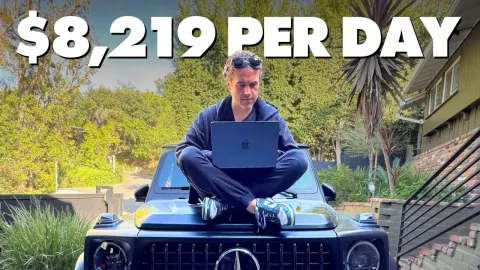


What's up, guys? It's Graeme here, and this is the most unbelievable market that I have ever seen. Believe it or not, we are in the middle right now of one of the strongest stock market rallies ever in history. We're back near brand new all-time highs. And what's crazy is that this isn't just applying to stocks. For example, home sales are also increasing. Bitcoin is up 13%. And this might officially suggest that we're beginning to see the start of the great meltup where asset prices balloon to levels we never thought were imaginable before eventually everything goes to sh. That's why we really got to talk about exactly what's happening, why the Federal Reserve decided not to lower
interest rates as of a few hours ago, if this is something to be concerned about. And then most importantly, how you could use this information to come out ahead. Because like it or not, this could be the last phase of the cycle where everyone feels rich right before the bill comes due. Although, before we start, as usual, if you appreciate breaking news videos like this that I try to get out as soon as possible, it would mean the world to me if you hit the like button and subscribed if you haven't done that already. I know it's dumb to ask, but it was just my birthday and as a birthday wish, that's all I ask for. And as a thank you for doing that, here's a picture of a frog. So, thanks so much. And also big thank you to Surf
Shark for sponsoring this video, but more on that later. All right, so before we talk about what the Federal Reserve just said, why Jerome Pal is soon going to be leaving, and what to expect for the future, there is one giant problem getting in the way, and that would be inflation. See, here's what most people don't realize. Behind every price tag, every product, every shipment is one commodity that quietly controls the cost of pretty much everything, and that's oil. Remember, oil doesn't just power your car. It powers cargo ships, trucks, planes, tractors, factories, plastics, packaging, fertilizers, and the entire supply chain that gets everything into your hands. So when the cost of oil goes
up, the cost of everything else rises almost immediately. And in this case, it was found that every $10 a barrel increase in the price of crude oil raises inflation by2% and sets back economic growth by.1%. To put that into perspective, just a few months ago, oil was trading at $57 a barrel, but now it's over $100. And from this alone, we could see inflation increasing by roughly.7%. And like I said, it's already begun to happen. For example, last month inflation increased back to 3.3%. And even though it seems like the worst is behind us, keep in mind that reading was before oil reached its all-time high, which implies that this next month could be significantly worse. It's for this reason that the Federal Reserve has
essentially frozen or paused any chance of a rate cut this year with right now the market pricing in the next rate cut in October of 2027. So, in terms of what to expect, why we're starting to see a generational meltup and what the Federal Reserve just warned us about a few hours ago, there's another topic that is worth considering, and that would be the stock market. When it comes to this, here's what's crazy. By all metrics, stock prices are setting non-stop records. Like we've just seen a 10% rally in 10 days, which is one of the strongest we've ever witnessed. It went from oversold to overbought in just 11 days, the second fastest on record. And the NASDAQ saw a 13-day win streak, the most
in 13 years. However, here's where things are getting incredibly interesting. At the same time, the stock market is doing incredibly well. Consumer sentiment is hitting its lowest point in the survey's entire 70-year history. And when these two things happen simultaneously, that's a sign that something's about to break. So what's going on? Well, here's the uncomfortable truth. The stock market and consumer sentiment are literally measuring two completely separate things right now. The stock market is extremely forwardinking. It only cares about what's going to happen 12 months from now. Things like corporate earnings,
trade resolutions, and future growth. Consumer sentiment, on the other hand, measures how everyday people feel about today. things like grocery prices, oil prices, their job security. And that's why we're seeing that Wall Street is betting on tomorrow. Main Street is living through today and the worlds are completely separate. Now, even though this might sound like a dystopian universe where the top rich people get really rich and everyone else is kind of left to fend for themselves, believe it or not, when consumer sentiment is at a low, historically, that's actually been a rather good time to invest because when sentiment starts to improve, stocks just keep melting up higher. And usually
the best prices are associated with maximum pain, not necessarily the maximum price. Although, even with all of that said, I will admit I am in constant disbelief by how quickly the market has returned to all-time highs. Like, objectively, we still have a mess of an economy with oil. All rate cuts this year have been completely wiped off the table. Inflation is still an ongoing issue, and somehow markets just keep going higher. That's why I'm such a firm believer that you cannot time the markets. You have no idea what's going to happen a week from now. And even though everything might look pessimistic, the markets don't care.
Like we could see an all-out destruction of our economy, but the market keeps going higher because they think we'll build back even bigger tomorrow. Or we could have all this good news in the world and things sell off because people just want to take profit. Point being, we have watched the market fall in one of its worst stretches in years to one of its strongest rallies ever in history in 10 days. The people who sold at the bottom to wait for clarity missed the entire rally. And the irony is that the market is always at its best price when things look the most uncertain. And it always looks the most safe right before it drops. To me, that's just why it's so important to keep investing and stay the
course no matter what. Because most likely, we're not going to outperform the hedge funds and all the people with insider information that know what's going to happen before it actually happens. We just can't compete with that. But we can join the same ride alongside with everyone else by just investing long-term. So, in terms of what this means for you, how this is likely going to impact everything else like home prices and what Jerome Powell just said at his last meeting ever with the Federal Reserve, here's what you came for. Although, before we go into that, it's important to understand the bigger picture. Because this isn't just about a single headline. It's about a broader shift throughout our entire economy. And when that happens,
protecting yourself isn't just financial, it's digital, too. For example, during times of uncertainty, more people are logging into bank accounts, moving money around, and checking on their investments, which often means more exposure on public Wi-Fi, airports, and unsecured networks. That is exactly where using a VPN becomes crucial. And what a coincidence, our sponsor, Surf SharkVPN, is there to help. They're able to protect your personal information by encrypting your online data, masking your IP address, and preventing hackers from identifying your city, country, or download history. or basically a VPN is able to swap the real location of your device with the new one, giving you the ability to
virtually travel anywhere around the globe. This means anytime I'm out of the country, like I was just recently in South Korea, I'm able to switch my location back to the United States so that everything works normally, or if there are shows that are only available in select countries, I could instantly change my location and watch them from wherever I am. On top of that, Surf Shark's clean web feature also blocks ads, trackers, malware, and fishing attempts, allowing you to surf the web safely. Plus, they don't track, store, or monitor what you do online. This means there's no connection or activity logs whatsoever. So, you could rest assured your activity is private. Look,
in all seriousness, every single time I'm online, I just connect to a VPN because it takes you a split second. And if you don't control your own data, then someone else is. So, if you want to try it out for yourself, just visit surfshark.com/gra or use the link down below in the description and use the code graham at checkout to get an extra four months for free. They also have a 30-day money back guarantee so that you can try it out for free and just see what you think and get a full refund if you're not 100% satisfied. Again, that link is down below with a good gram. Enjoy. Thank you so much. Now, let's get back to the video. All right. Now, in terms of what the Federal Reserve just said, what's
happening with your money, and what's going on throughout the rest of the market, there are two more topics worth considering, with one of the biggest surprises being Bitcoin. Just consider that during a month when the S&P 500 is up 12%, Bitcoin is up 13%. And even though it's still down from its all-time highs, higher prices are still looking more and more likely in the near future. Why? Well, the start. A lot of institutional money is flowing back into Bitcoin ETFs. Strategy officially overtook the US government is the largest holder of Bitcoin. Schwab City and Goldman Sachs are all soon offering their own cryptocurrency projects. And
with the national debt continuing to rise, people are looking for alternative ways to hedge their money. Now look, objectively, Bitcoin is still down about 30% from its peak. And yeah, when it fell to $60,000, that was rough to see those types of losses in your account, especially when everyone was saying this time Bitcoin is actually done for. It's never going to come back. Even with all the institutional ETFs, it's still going down in price. We're done forever. But my gosh, literally every single time I start to doubt myself, turns out to be one of the best opportunities to buy because since then, it's up quite a bit.
Like for the last couple of months, I have been doubling down on buying Bitcoin ETFs. When my account was red, I just kept shoveling more money back into it to lower my average cost. And I'm glad I did so far because from the very bottom I'm up about 25% in just about 2 months. Now, even though it very easily could have gone the other way and kept going down in price, I've just noticed that when you do the opposite of what the general market believes, it usually works out in your favor. So, when everyone says, "Oh, it's going to keep dropping. I'm not going to buy until it hits 30K."
Tends to be the very bottom. Just from my experience. Now, the same thing also applies when everyone believes, "Oh, it's going to hit a million dollars. It's going to hit $250,000 this year. Maybe that's also a good time to sell in hindsight." Okay, keep in mind, I'm still less than 15% of my entire portfolio in a Bitcoin ETF. So, it's not like I'm going all in on this, unlike some people. But, I am long-term optimistic for the future, unlike the next topic, and that would be the housing market. Believe it or not, despite national home prices rising 1.4% 4% year-over-year. Sillow just downgraded their forecast across 400 markets, predicting that over the next
12 months, prices would rise by a whopping 0%. Of course, do keep in mind that this is the national average, which means just as many places will be going up in price as will be falling. But in terms of where the biggest changes are happening right now, here's what I found the most surprising. They think that prices will be completely flat around the west coast throughout California, Oregon, Washington, and Nevada. Larger drops are anticipated throughout the Sunb Belt regions like Texas, Louisiana, and Florida. And price increases are commonly seen throughout the northern markets like Chicago, Rochester, and Connecticut. Why? Well, it's pretty straightforward. The areas seeing the
biggest declines are also the ones that saw the biggest runups over the last few years. And now that prices have risen to a level that most buyers cannot afford, prices are coming back down. Will buyers relocate to other areas that are more affordable, which happens to be in the Northeast, where you could still buy a decent house for $350,000. However, the one sticking point for housing prices, regardless of location, is really just all going to come down to two words: mortgage rates. The reality is higher oil prices have led to higher inflation expectations, which has led to higher mortgage rates. The entire market is more interconnected than most people could even imagine, and as a result, borrowing costs have remained pretty
high. Although, the good news here is that this is not going to last forever. But any decrease is probably not going to be as meaningful as you'd expect. For example, Yahoo Finance argued that mortgage rates could fall to just 5.7% by 2030. Except even that would only increase a buyer's purchasing power by about 5%. So, yes, it helps, but it's probably not enough to turn someone who can't afford to buy a house today into someone who suddenly can. But in terms of what this means throughout the rest of the year, I've said this before, but it really depends on who you ask. Like, Redin believes we'll see a 2.6% increase throughout the end of the year. The National Association of Realtors thinks
we'll see a 4% gain. Zillow is back down to 0% and JP Morgan seconds this also believing that we'll see no appreciation whatsoever. Even anecdotally, I'm seeing a lot of softening here in Las Vegas. Like, I can't tell you how many properties that I am seeing selling at a 5 to 15% loss from where they purchased in 2021 to 2023. These are people who locked in at record low interest rates only to sell at a massive loss before commissions only because so much inventory is coming on the market and there's a lot to compete with. That's why I'm seeing a lot of buyers on the sidelines right now cautiously watching the market. They know there's no urgency to buy something immediately. If they
miss out, there's going to be something else listed, probably at the same price or less in the next few months while they save up. And sellers are beginning to recognize this by pricing their homes a little more aggressively and being willing to negotiate. So, in terms of what this means for you, what Jerome Powell just said at his very last meeting, and what you could do to come out ahead from this, here's what you need to know. All right. So, in terms of what Jerome Powell just said at his very last meeting, no surprise on a broad scale, there will not be any interest rate cuts for the foreseeable future due to ongoing inflation concerns, rising prices, worsened consumer spending, and
a fragile labor market. Although, here's where things get interesting. As of right now, Jerome Powell is scheduled to end his term at the Federal Reserve on May 15th. And then shortly after, it's expected that Kevin Worsh is going to take his place, giving him a guaranteed 4-year term within the Federal Reserve. Now, even though Kevin Worsh was specifically nominated by Donald Trump, who has been pushing non-stop for lower interest rates for years, Kevin Worsh did say that monetary policy independence is essential and they must act in the nation's interest with unclouded decision-making. Basically implying that he's not just going to be a puppet for whatever Trump wants him to do. But then again, that's probably also
exactly what he'd say, even if he did push for lower interest rates. and he could always argue that it's in the best interest of the United States to lower interest rates, which just so happens to be what Trump wants. But he didn't influence us. Promise you that. We came to this by our own conclusion. So actions at this point will speak louder than words. However, do keep in mind that since 1930, once a new Fed share takes office, the stock market sees an average decline of 16%. And Kevin Morris is taking office at a time where he openly wants to shrink the Fed balance sheet, meaning less money printing.
We're already nearing similar levels to the dot peak. And this could be a very interesting time to watch, even though in the past everything we thought was going to happen never happened. So take that with a grain of salt. So in terms of my own approach, what I think is going to happen over the next 12 months and what this means for you, here's what to keep in mind. In all seriousness, there's one thing that I just keep coming back to. Every single time without fail that I think I have the market figured out, that I know what's going to happen, that I try to be clever, the opposite happens. Like even if you take all the data, analyze it correctly, and make a move, one tweet, and the entire thing changes. Like the
people who've sold in April missed out on one of the fastest rallies ever in history. The people who didn't buy Bitcoin at $60,000 because it's going to $50,000 just missed out on almost 30% upside. And the market always seems to make you feel the most confident right before it humbles you. That's why I just keep saying the same thing. The only strategy that consistently works is when you decide how much money you want to invest every month. Pick an allocation that you could live with through a 30 to 50% draw down and then just don't stop. No matter what Jerome Powell says, no matter what Trump says, no matter who replaces him, no matter what oil does, no matter what inflation does, it doesn't matter. You
just stay consistent. No matter what. I've been saying this non-stop since you could look back at my old videos, early 2017. Back then, I remember making a video and the S&P 500 hit its all-time high in the 2000s. And back then, people were worried about a bubble or a big market crash. And I said, "Well, historically, it's usually best to keep buying in." And had you done that, you would be up like 200 plus percent since then. Oh, it was a great time to buy. And hey, that's not to say that we can't see a drop. And who knows, maybe there's a black swan event in a few months and we're down 50%. Who knows, maybe I've just jinxed that into existence. But regardless, long-term, that's the only
strategy that has worked and I put my money where my mouth is. Every single day, I buy in a consistent amount regardless of where it trades. And so far, that's worked really, really well, just like hitting the like button and subscribing if you haven't done that already. And by the way, if you want early access to videos like this along with bonus videos every single week that I don't post publicly, feel free to join as a channel member. Helps out tremendously. And I'm posting a lot of videos over there that I just don't have the time to make a dedicated video for here. I even just posted my entire watch collection for everyone to see. I'm talking everything I have, what I paid,
what it's worth, what I look for when I buy a watch, everything. So, if you want extra content, feel free to join.

Read the full English subtitles of this video, line by line.