20:20


you've been an academic for a long time now. How well do you even remember writing your thesis? Well, I don't know how to quantify that how well, but I certainly remember it. And what one thing that I remember quite vividly is after uh I derived the first rotation curves for uh some of the galaxies that I was studying together with my thesis advisor uh David Rogad. He passed away fairly recently I believe. Anyhow, uh when I found this, you know, flat rotation curve, in other words, that the galaxy was spinning very rapidly in its outer regions indicating that there was more mass there than could be, you know, uh explained by the number of stars in that area that I felt that I had made a mistake somewhere
in the analysis. I kept reviewing my software, my coding, my programming to see if I had found or if I could find some sort of error in the uh in the in the software that would account for the fact that these rotation curves went up. That wasn't surprising, but then didn't come down very quickly, if at all. And uh you know in retrospect of course this was telling us about missing mass dark matter so forth but at the time nobody was talking about that sort of thing. So uh that's what I remember. I remember walking home from the or walking back to well my apartment uh in Pasadena from the computing center and worrying about what was wrong with my software.
Clearly at some point you obviously trusted the data and trusted your software because that's what you went with in your thesis. So what made you trust it? What made you know what got you to that point of thinking no that's it. There's obviously mass out there. Yeah. Well I think it was the failure to find anything wrong. I mean you know I'm I'm one of the first people to admit that making mistakes is something that I frequently do. But in this case, I simply could not find any way to explain these flat rotation curves other than to accept the fact that the galaxy was spinning too quickly. And as I say, in retrospect, of course, it all seems fairly obvious. But at the time uh
anybody who published anything about determining rotation curves of spiral galaxies which is the kind of galaxy of course that NGC 2403 is u they always assumed that okay you know the rotation sped up as you went out from the center but very quickly it would decrease and it would become what's called kept in other words you would get to some point in the galaxy where you were really outside beyond on the limits of all the major mass in the galaxy and then it would start re you know the rotation would slow down and nobody expected that it would stay rotating but as I say you know you just try one thing after another and you look at your code and you know you dream about it and that kind of thing and eventually I just concluded that you
know it was rotating too quickly and of course writing your thesis you don't lie you just you know put down the facts Professor, if I could go back in time and ask the younger you who just found this discrepancy, what the heck do you think's going on? What kind of answer do you think you would have given me? Were you speculating? Were you talking to your supervisor? Did you have any wild theories? Or was it just like a complete mystery to you? I think it was pretty much a mystery. I mean, you I knew that there had to be some mass out there to account for this fast rotation, but you know, you couldn't see it. I mean, it wasn't luminous. It wasn't stars, at least not luminous stars. I
mean, it could have been, and as I said, I think at the time, it could have been footballs. You know, the galaxy could have been filled with footballs, which don't make a whole lot of light, but if you have enough of them, they might, you know, provide enough mass to account for this peculiar phenomenon. I didn't know what it was. And uh I think that actually is still the case. We don't know what the dark matter really is. But we do, you know, it's generally accepted that it's out there because this phenomenon wasn't just found in one or two galaxies. It's been found in every galaxy where we had data to determine the rotation. Is there any part of you that thinks there was like a missed opportunity for you to be Mr. Dark
matter? for you to have been the first person to kind of pin down this mysterious substance that's now so famous. Well, yes, of course. I mean, you know, when you later in later I mean, it's like many things that uh you know, were discovered in that era when you thought, gosh, you know, I could have written that paper, right? I had the data, but you know, that's all the benefit of hindsight. Um there's something called the Tully Fisher relationship for example which was used for a long time to determine the distances of galaxies and you know we had the data to have determined that too but sometimes you know other people interpret things in a more daring way than I did or that anybody does really. And so I think that's very common in
science that they're they're missed opportunities for sure. I have to say Brady years ago I attended a talk given by an astronomer whom I knew quite well uh he worked in the Netherlands tier van Albada he's still around but but Tur you know gave a talk in which he had looked into all this because he was a theoretician he was interested in this business of the rotation curves of galaxies and he you know his talked over and over again. He said, "Well, then Shastack found this and Shastack found that." And the guy who was sitting next to me who was a buddy, you know, he turned to me because this was a surprise to both of us. He turned to me and he said, "Well, what does it feel like to be famous?" I said, "Well,
I don't feel any different than I did 10 minutes ago, but which" which was true, of course, but uh you know, it was being brought to my attention by this talk that there was really something of importance in this I quickly want to ask you about your your dedication uh to you dedicating your thesis to inhabitants of NGC 2403. Why did you do that? I think I was just being a wise guy. I don't think there was anything very deep in any of that. I mean I looked at the dedications of other thesis and you know they followed the pattern you would expect. I mean people would d you know dedicate it to their wives or girlfriends or whatever or boyfriends. I mean that was common and I just decided to dedicate it to NG2403. That was the result of about one
minute's worth of thought. Did it get any comment from your supervisor? No, no, no. He didn't. I'm not even sure he read it, but he never said anything about it. No, my advisor as they say I had several I had three adviserss actually now that I think about it. Uh there was not just David Rostat whom I've already mentioned. He was a posttock at Caltech and I worked most closely with him. He was a pretty clever guy actually. He's unfortunately he's died recently which is too bad. But in any case, but I also had other uh adviserss including I think the most important of them was a guy by the name of Allan Moffett. He was also u you know working at Caltech at the time and he was a pretty clever guy as well and he
had always some insightful stuff to say. My third adviser was a fellow by the name of Martin Schmidt. He was not a radio astronomer. In fact, he was not really an observation as much, although he did do observation. But Martin Schmidt was uh most remembered for having discovered quazars. Uh and you know, because he also had found something that was very peculiar. He had found these objects in the sky that just looked on a you know, on a photograph like stars. So they were just points of light, but they were they tended to be blue. But also if you know made some estimate of how far away they were there were techniques for doing that. These things had to be intrinsically extraordinarily bright and
they also produced radio waves. So they were called quasi stellar radio sources or you know things like that and of course that became quazars and he was on the cover of time magazine when I was a student that was a big deal you know we'd see him in the halls and this celebrity Martin Schmidt but he was a very nice guy and uh he you know he wasn't really the most influential of my advisors that was Dave Rostead but Martin Schmidt would ask questions like well Seth you know have you thought about what you might find by doing this kind of work trying to map the speed of rotation of galaxies in their outer regions using radio astronomy and you know I hadn't thought terribly much about it he said well why don't you
write some software to sort of simulate uh you know what might happen and see if you could you know figure out what's going on and that was a good suggestion I did do it as well uh he was insightful of course with the benefit of hindsight, one would think that your dedication there was sort of foreshadowing what you later did at SETI. It showed you already had this uh this extra interest. You mean in the inhabitants of NGC24? Yeah. Uh well of course I was interested in SETI uh right from I mean I think that's why I went into astronomy because not so much because I was interested in how stars work the physics of stellar interiors or anything like that but it was the idea of life in space and of course that was simply a reflection of
the sorts of things I was interested in as a kid the kind of books I read and you know which planetarium shows I went to so forth. I mean, there was a lot of science fiction in the movies. That's another interest of mine. I've made films for a long time. In fact, you can probably see a some equipment back there for that. But, um, you know, so I was interested in STEI. I mean, as a kid, I was interested in the Ando Life in Space, but that's because of the movies I went to. Most of the time, those aliens, by the way, would come to Earth and mess things up here. Do you have a special bond with NGC 243 now? Is it what like do you keep an eye on it?
Would you love that to be, you know, a place where evidence of life was found? Well, I think it would be quite hard to find evidence of life in NGC24 3 unless you picked up a radio signal or maybe a la flashing laser. It's far away. I mean, it's like three megapars away. So, uh, that's, you know, that's many millions of light years away. It's quite far. I mean, it's close compared to just about anything else in the deep sky, but you know, compared to the kind of distances we regularly talk about here in this part of the galaxy, it's it's quite far. So, it would be very difficult to find life there or unless you could find, for example, as I say, a radio signal, flashing laser, some sort
of signaling effort by anybody who happens to live in NGC 2403. But on the other hand, if you're looking for life, you know, most people don't look that far away. You can look for life in our own solar system, places you can reach with a rocket. So obviously that you know offers opportunities you can't consider when you consider NGC 243. And by the way, there was one of three galaxies in my uh thesis. Uh the second one was also kind of a spiral galaxy, but it was seen on edge. And the third was an irregular galaxy IC10 in the southern hemisphere, which is, you know, just a blob of hydrogen really.
I'll I'll ask you this, but I don't I can guess an answer. How likely do you think it is that there are inhabitants of NGC2403, as you referred to? Yeah. Well, I would bet my next month's paycheck, which uh given I'm semi-retired, is not terribly large, but yeah, I'm sure there are. Look, the number of stars in NGC 2403 is, you know, it's on the order of maybe hundreds of billions. And yeah, most of those stars are kind of worthless for supporting life on a planet around them because they're too bright or they're too dim or something like that. But nonetheless, 10% of them are probably okay. So that's still a very large number of star systems. And unless
you are convinced that the origin of life is some sort of miracle, some sort of highly unlikely event, then life will have arise risen uh you know on many planets you know billions and billions as Carl Sean would occasionally say in that galaxy and uh you know maybe most of that life is not terribly interesting. it's all single-sellled life or insects or something like that. But, you know, it's it's hard to believe that advanced life, you know, that has the capability to invent science and do science, things like that is restricted only to this planet. We have a lot of history that suggests every time you think you're very special, uh, you're usually wrong. So, I realize it was a
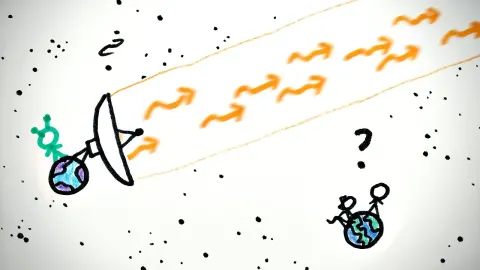
bit of a glib sort of throwaway line at the end of your thesis, but you did offer to send a copy of your thesis to NGC2403. Has it ever occurred to you to do it to send it to transmit it? You don't need to send it by post, obviously. Has a Have you ever thought, "Oh, could I point something somewhere in the right direction and figure out where it's going to be in X number of years and zap it up there?" Well, that's an activity known as active SETI where you broadcast instead of listening. I've always been involved with listening projects. Uh transmitting broadcasting sounds kind of interesting because you might provoke a response. But you know even if you assume there are I don't know just name a number a
million other societies in our own galaxy then the distance to the nearest other society to the nearest other one is still hundreds or even thousands of light years. So, you know, you send them a message, you somehow commandeered a very powerful transmitter. You aim it in the direction of uh, you know, these guys that might be say a thousand, let's say a 100, make it easy, a 100 light years away, you know, hi, we're the Earthlings. We'd love to get in touch with you guys. Uh, it'll take a 100 years for that signal to get to them. And if they reply, that's another hundred years. So, 200 years will have gone by and will not be of great importance to you. uh what they say it'll be of importance to some people I
suppose but you know so that kind of an experiment you know it's it's it's kind of discouraging when you look at what the implications are of trying to deliberately signal and besides I mean even aside from all that we've been signaling willy-nilly for roughly a century into space mostly with our high frequency high-powered radio and television and radar transmissions So, we've already been signaling the aliens, and if any are relatively nearby, you know, they'll be able to pick that stuff up and decide what to do with it. I guess I'm not talking about doing it, you know, in the search for extraterrestrial intelligence. I mean, just to make good on your promise.
Well, you mean to offer them copies of my thesis? Yeah. You know, you said you'd offered it to them. Make good on your promise. Send it out there. There you go. I said I'd send it. You've got it. Yeah. Well, I'm waiting for them to reply. you know the sky is big so you don't have the opportunity to transmit the thesis uh to the entire sky. I mean you can but only at very low power. So if you want just to NGC 2403 where you said you'd send it. Yeah. Well I think the fact that it's you know hundreds of millions of what is it? Billions of light years away. No it's three mega parses. So it's millions of light years away on the
order of 10 million lighty years away. You know, they're not in any great hurry, I would assume. Slightly self-indulgent, I guess. Well, also it's it's it's difficult and expensive. I mean, there's the problem. Who would pay for it? There's I mean, we talked a little bit about active SETI, you know, where you actually broadcast something and uh people will ask, well, isn't that dangerous? you're just drawing attention to yourselves. I mean, that's a question I get a lot. And then also, um, what would the aliens be like? That mostly comes from Southern California where the movie industry is because, you know, they're trying to portray aliens in a TV show or a film and they want to know what science can say about what
they look like, which by the way is precious little. But my personal uh opinion is that most of the aliens out there that are clever enough to, you know, either broadcast or receive signals are probably machines anyhow. Probably machine intelligence because that's what we're doing. We're developing machine intelligence, AI. It's in the papers all the time. I mean, it's it's, you know, it's not terribly threatening or even capable at this point, but 100 years from now, that might be quite different. is what makes the subject interesting in the first place. So this was this guy Seth Shostak's thesis. Um and couple more things to say about it. So let me read I just read a bit from what he actually said about the detection or
how he how close he got to the detection of dark matter. So this is from the conclusions of his thesis. It says the flat rotation curve of NGC 2403 seen in other late type spirals