38:52
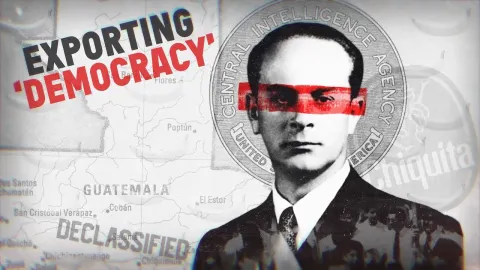


Washington DC 1976. A car bomb explodes on Embassy Row, less than 2 km from the White House. In Bolivia, a wanted Nazi is advising a US-backed dictatorship. 24 years later, a fast food worker in Buenosides is handed a note. I am the daughter of the disappeared. I'm looking for my brother. I think he might be you. These were not random events. During the 1970s and 80s, across Latin America, US-backed military dictatorships built a shared system to identify, track, kidnap, torture, and erase their political opponents. Even if those opponents fled across
borders, even if they fled across oceans. This was a secret war without front lines that disappeared tens of thousands in a war on democracy itself. an alliance of death, the results of which are still being dug up. This was Operation Condor. On the eve of the Second World War, most of Latin America was ruled by dictators who maintained the interests of a tiny class of landowning elites, usually descendants of European settlers who controlled vast estates, while millions lived in poverty, malnutrition, and near feudal conditions. One in seven infants never made it past their second birthday. Men and women kept illiterate
by design labored in fields and mines while their children died from tuberculosis. The wealth they produced, the coffee, the beef, the cotton, the fruit, the lumber, the petroleum, the rubber did not remain where it was created. It flowed into the balance sheets of giant US corporations. Washington's interests in extracting cheap resources merged with the elites in these countries who wanted to keep their privileges. Across the region, Washington supported friendly dictators who kept the elite class in power and resources cheap. And when that failed,
the United States sent in the Marines. But after the Second World War, across the continent, new mass movements of peasants, workers, and students demanded control of their own resources so that those who work the soil might finally eat from it. They wanted the right to choose their own governments. And they demanded something even more fundamental, the right to read and write, to see a doctor, to see their children grow up healthy. In 1944, the people of Guatemala, long shackled under a dictatorship that served the Boston-based United Fruit Company, threw off dictatorial
rule and built a democracy. Guatemala, a majority indigenous nation, was one of the poorest on Earth in which nearly all the land was in the hands of a tiny elite class. Their elected president Hako Arbenz bought the unused land of the largest land owners and gave it to peasants to help develop the economy. The United States called this communism and in collaboration with the United Fruit Company began operation PV success. From secret bases in Honduras and the USbacked Samosa dictatorship in Nicaragua, the CIA assembled a small army of right-wing exiles that invaded the country while
American planes bombed Guatemala. On the 27th of June 1954, President Jacobo Arbenz went into exile. His replacement would be a dictator, Colonel Carlos Castillo Armas, who had been trained at Fort Levvenworth in the United States. The CIA drew up kill lists of subversives to eliminate post coup. Within weeks, hundreds were rounded up and shot. Guatemala will be ruled by a series of right-wing military regimes for the next 35 years. That would kill 200,000 Guatemalans and send a million into exile. In 1960 in Guatemala, the US military set up what became known as death
squads. Covert paramilitaries that murdered massive numbers of targeted groups. In the classified 1967 State Department memo reported, death squads they trained carried out abductions, bombings, street assassinations, and executions of real and alleged communists. The kill lists, the dead squads, the destruction of reform in the name of anti-communism became Washington's new template for Latin America. Fidel Castro emerged triumphant after 2 years of guerilla warfare against the Batista regime. The 1959 Cuban Revolution toppled the USbacked
Batista dictatorship. Washington panicked. They tried to do in Cuba what they did in Guatemala, training a group of exiles to invade the country. But their invasion at the Bay of Pigs ended in a Cuban victory. Preventing new Cubas became an American obsession, but direct invasion was deemed too risky. So they decided to delegate repression to the Latin American militaries themselves. The Phoenix program was a secret American operation in Vietnam. In 1966, US Army booklet described their use of terror squads that spied on, detained, tortured, and eventually killed
suspected civilian sympathizers of the Vietkong. Targets of the Phoenix program were brutally murdered along with their families or neighbors as a means of terrorizing the neighboring population into a state of submission. This program neutralized over 80,000 people. In 1946, the United States founded the School of the Americas in the Panama Canal Zone, which was controlled by the United States, and there they trained Latin American cadets. The Phoenix program model and even its operatives were exported from Vietnam to the School of the Americas. By the late 1960s,
the School of the Americas was teaching courses on communism, counter subversion, and psychological warfare. The School of the Americas armed cadets with torture manuals based on Vietnam that taught them to use fear, payment of bounties for enemy dead, beatings, false imprisonment, executions, and the use of truth serum. In Vietnam, the United States fought as an occupier. But the logic of that war, that all civilians were potential insurgents, was drilled into Latin American cadets to use against their own civilian populations. In 1962, US A sent Dan Mitrion to Brazil to train
their police forces in electric shock torture. Two years later, they sent Mitrion to Monte Vido to train Uruguayan police on torture using the homeless as practice. This police training was not to combat crime. It was training to hunt subversives, which meant anyone that questioned the ruling oligarchies. The dominoes had been set up. Now they just had to watch them fall. Brazil elected President Goulart in 1961. He began a land reform program to address the country's poverty and stagnation. The oligarchy panicked, so did Washington, and CIA money began pouring
into pro- coup paramilitary groups. On the 27th of March 1964, the American ambassador in Rio Janeiro Lincoln Gordon asked the White House to send a clandestine delivery of arms in order to be in a position to render assistance at appropriate time to anti-Goulart forces. On the 31st of March 1964, the Brazilian military staged a coup. Goulart was removed and General Castello Branco took power, starting a decadesl long military dictatorship that tortured and imprisoned thousands. Gordon called the single most decisive victory of freedom in the midentth century. The Brazilian economy was
cracked open. Profits repatriated from Brazil to the United States skyrocketed. Indigenous peoples were massacred and their land handed over to cattle ranchers. malnutrition soared and infant mortality increased by 45%. The Red Cross noted that Brazil became the world's leading exporter of blood as the poor sold themselves to survive. Nixon: We extend our very best wishes to all the people of your great country. Thank you for coming at this time so that we could meet. Brazil became Washington's enforcer in South America. When Nixon met with Brazil's new
military ruler in 1971 to discuss overthrowing Chile's democracy, he told them there were many things that Brazil as a South American country could do that the United States could not. A 1972 CIA memo stated Brazil's role was to use covert action to oppose leftist regimes to keep friendly governments in office or to help place them there in countries such as Bolivia and Uruguay. Cardinal Paulo Arens, who lived through and documented the Brazilian dictatorship, noted that Brazilian forces learned the new tortures of the United States and taught torture in Argentina,
Uruguay, even Chile, Bolivia, and Paraguay. In 1969, the Brazilian regime institutionalized this repression. It created a joint police military operation known as OBAN in Sao Paulo to infiltrate civilian groups, eliminate opponents, and to make resistance feel futile. Oban officers were trained in the United States on wiretapping, infiltration, and how to track subversives across borders. Brazil built a surveillance state and then trained its neighbors to build one, too. In Bolivia, a popular revolution brought in President Juan Jose Torres, who nationalized mines and launched a development program. In 1971, he was
removed in a Brazilian and US-backed coup. Colonel Hugo Banzer, a school of the Americas graduate, took power with support of landowning elites, the Brazilian and Argentine militaries, and the CIA. Among his advisers was Klaus Barbie, a former Gestapo commander, a Nazi war criminal. the United States smuggled to South America. Torres' reforms were rolled back and Banzer and Barbie unleashed a wave of repression and torture on Bolivia. Uruguay was the oldest democracy in Latin America. In 1964, the United States began training Uruguayan security forces. The International Police Academy in Washington and the School of the Americas produced a cadri of officials who would return to Uruguay as
missionaries of American counterinsurgency methods and doctrine. In 1967, due to a collapsing economy and increasing repression, a Marxist guerilla movement known as the Tupamaros began fighting the Uruguayan state. In 1970, they killed the torturer Dan Mitrion. The Tupamaros posed little threat to the state. By 1971, Washington and Brazilia were worried about something else entirely. A new left-wing coalition, the Frente Amplio, was expected to perform strongly in the upcoming Uruguayan elections. Brazil's military drew up plans to invade the country if the Frente won.
US and Brazilian trained security forces began to attack Frente candidates. In the election, the Frente lost and Juan Maria Bordaberry became president. The classified documents show President Nixon bragging to the British prime minister that the Brazilians helped rig the Uruguayan elections. Nixon was even caught on tape. I think this medicine thing is a good idea. I had a very good time with him in lunch and he was He's quite a fellow, isn't he? He is. God, I'm glad he's on our side. Strong and uh you know, you know, I wish he were running the whole continent. I do
too. We got to help Bolivia. He's concerned about that and we got to be sure. Incidentally, the Uruguay thing, apparently he helped a bit there. And another thing, Bordaberry and the Uruguayan generals wiped out the Tupinaros by early 1973. In June of 1973, President Bordaberry performed a self coup, bringing in a military dictatorship. Uruguay's democracy died. Congress was dissolved. Unions were outlawed. The local Uruguan economy was opened up to international corporations, which destroyed local businesses that could no longer compete. The Uruguayan state then
borrowed millions from the United States, creating a crushing debt. Debt holders could then demand that Uruguay cut social and health spending. Wages froze and people were left destitute. In a 1976 report, Amnesty International stated that tiny Uruguay with a population under 3 million possibly had more political prisoners per capita than any other country in the world. One in five Uruguayans fled into exile. Over the length of the dictatorship, over 20% of all citizens were detained, which frequently included torture. Informants were everywhere. Fear and self censorship gripped society. As one Uruguayan put it,
the whole country was run like a prison. The actual prisons were merely the punishment cells. in September of 1970, Chile elected the socialist Salvador Allende as president. He initiated a campaign to develop the country, investing in education, infrastructure, land reform, and reductions in poverty. Chile was the world's leading producer of copper. Ashende nationalized the mines in 1971, redirecting profit from the United States back to Chile itself. After Ashen
won the election, President Richard Nixon and his national security adviser Henry Kissinger ordered the CIA director Richard Helms to make the economy scream. The policy as stated by the US ambassador to Chile, Edward Curry, was that not a nut or bolt will be allowed to reach Chile under Ashende. We shall do all within our power to condemn Chile and the Chilean to utmost deprivation and poverty. Nixon said in a National Security Council meeting on the 6th of November, 1970, "No impression should be permitted in Latin America that they can get away with
this." Kissinger said, "I don't see why we need to stand by and watch a country go communist due to the irresponsibility of its own people." A CIA memo from the 12th of November, 1971 noted, "We conceive our mission as one in which we work consciously and deliberately in the direction of a coup." The United States paid assassins to kill loyal generals, cut Chile off from global finance, and stoked unrest in the country. But Allende's reforms remained popular, and he increased his vote share in the next election. Henry Kissinger refused to let this continue.
He would not stand for a successful elected Marxist government in Chile. The presidential palace is under attack. September 11th, 1973. Chilean air force jets roar over Santiago. They bomb the presidential palace. General Pinochet ordered the attack. He and his coup plotters demand the state submit to military rule. Allende refused. He stayed inside the palace as it burned and spoke to the nation one last time.
Hours later, Allende's body was found inside the palace. Chilean democracy died with him. Chile today joined the list of South American countries to fall under military rule. General Austo Pinochet now ruled Chile. Many of Pinoett's officers had received training in the United States and Brazil. The arrests began immediately. Thousands of suspected Allende supporters were crowded into improvised concentration camps such as Santiago's National Stadium. In the months following the coup, it became a torture center for 12,000 people.
In November of 1973, Pinochet created a secret police force, the DINA, under the command of Manuel Contreras. Pinochet soldiers poured into the slums and working-class neighborhoods, the places that had voted for Allende. Doors were kicked in. Young people disappeared into trucks. By December, 18,000 prisoners languished in Pinochet's camps. An atmosphere of terror took hold of Chile. No one knew what was happening. No one knew where the arrested were vanishing to. More than a thousand people were executed in the days after the coup. The British ambassador in Chile noted,
"It is likely that the casualties run into the thousands, but most British businessmen will be overjoyed at the prospect of consolidation, which the new military regime offers. Pinochet's military followed their school of the America's training. The bodies were hidden, buried in unmarked graves, or dropped into the sea. They simply disappeared. In the days following the coup, Henry Kissinger sent instructions to his ambassador to convey to Pinochet our strongest desires to cooperate closely. One in every seven members of the Dina command staff were trained at the School of the Americas. In March of 1974,
Contras traveled to the United States to request CIA trainers for DINA. Shortly after, Dena opened its main center for torture and interrogation. Villa Grimaldi. Thousands of people were tortured here. Some survived. Others were tossed into the cold Pacific from helicopters. Today, Villa Grimaldi is quiet. The names of those that vanished here are carved into stone. With his advisers from the University of Chicago Department of Economics, Pinochet outlawed unions. He banned political parties. He sold the country to foreign buyers,
creating one of the most unequal societies on earth. BUSH: Thank you all very much. It's a an honor for me to be here to um pay tribute to a hero of freedom, Milton Friedman. He has used a brilliant mind to advance a moral vision. We have seen Milton Friedman's ideas at work in Chile. where a group of economists called the Chicago Boys brought inflation under control and laid the groundwork for economic success.* Some people have said that times are hard in Chile now that Chile can't afford a festival like this. Well, I think this is an acquired habit and we have to. I don't believe there's any torching done in this country. If they were tortured,
they deserved it. Why torture somebody when you can shoot them? Over 17 years, Pinochet arrested 130,000 people, tortured 20,000 others, and murdered unknown thousands. Under the weight of the secret police, the prisons, the torture, millions of Chileans refused to forget the disappeared and refused to surrender to Pinochet's demands for silence.
By June of 1976, Pinochet's repression was no longer a secret. That month, Henry Kissinger arrived in Chile to deliver a speech on human rights. Before giving it, he met privately with Pinochet to tell him that he could ignore it, that he was a victim of the leftist press. And in the United States, as you know, we are sympathetic with what you are trying to do here. Pinochet responded, we are behind you. You are the leader. Paraguay, Bolivia, Brazil, Chile, and Uruguay had all fallen under military rule by 1973. Tens of thousands of people from these countries fled to Argentina, the last outpost of civilian rule in the region.
The existence of these exiles in Argentina worried the military regimes who feared they could organize movements towards democracy. Buenos Iris the 30th of September 1974 Carlos Prats the former commander and chief of Chile's armed forces living in exile and his wife were driving home when a bomb detonated beneath their car. Both were killed instantly. The assassination was carried out by a squad of Pinochet Dina agents led by Chilean American Michael Townley and men connected to a secret Argentine government run death squad, the Argentine anti-communist alliance. The Prats
assassination was a rehearsal building on years of coordination that had radiated outwards from the Panama Canal zone. Augusto Pinochet moved to formalize this system. In November of 1975, Pinochet convened a meeting of military intelligence chiefs from Chile, Brazil, Bolivia, Argentina, Uruguay, and Paraguay. Manuel Contreras laid out the plan. Their intelligence services would no longer operate separately. They would function as one. They would share files, track dissident across borders, and conduct joint operations to eliminate subversives regardless of nationality or location.
Borders didn't matter. The Uruguan delegation proposed the name Condor. In 1976, the classified CIA briefing stated that the Latin American dictatorships are joining forces to eradicate subversion, a word which increasingly translates into nonviolent descent from the left and center left. Operation Condor had three distinct phases. Phase one was files and surveillance. First, a target was identified. a gorilla suspect, a student, a union organizer, a priest, someone whose crime was political activity. Condor agents then compiled dossas, names, photos, family ties,
political affiliations. They intercepted mail and phone calls, and tracked daily routines. Phase two was crossber raids. Files were turned into abductions. Once a target was marked, regardless of their location, a multinational team was sent out to detain them in a secret prison. There, intelligence officers from multiple countries participated in interrogation and torture. Beatings, electric shocks, stress positions, and waterboarding. Victims were frequently rendered back to their country of origin. In many cases, they disappeared forever. By shuttling prisoners
across borders and involving multiple intelligence services, Condor agents buried responsibility. Each state could deny ownership of the crime. Condor operations were not limited to one target at a time. In March of 1977, five people from Uruguay and Argentina were detained in Paraguay, interrogated and tortured by Paraguayan, Argentine, and Uruguayan agents, then transferred from Paraguay to Argentina where they disappeared. This was a paperwork-driven system sustained by constant reports, lists, and inter agency correspondence. A bureaucracy of murder
to eliminate subversives. Phase three was global assassinations to eliminate high value exiles. Specialized teams traveled internationally undercover or they used allied extremists such as Italian fascists or anti-Castro Cubans to carry out murders designed to act as deterrence proving that opposition would be eliminated anywhere. Zelmar Michelini was a Uruguayan politician for the Frente Amplio Party living in exile in Buenosides. He had been in contact with other Uruguayan exiles to try and plan a return to democracy in Uruguay. After the military seized power in Argentina in
1976 rather than flee the junta himself, Michelini stayed and helped refugee families escape. On the 18th of May 1976, three Ford Falcons pulled up to his residence. On the 20th of May, four bodies were found with shots to the head and neck. They belonged to Zelar Mitchellini, Uruguayan Congressman Hector Gutierrez, and married Uruguayan couple William Whitelaw and Rosario Baro. Baredo's three children, all under the age of four, were abandoned weeks later at a police station. On the 1st of June 1976, Juan Jose Torres, the ousted president of Bolivia,
living in exile in Buenosides, was found dead under a bridge, blindfolded, and shot in the head. Bernardo Leighton, the founder of Chile's Christian Democratic Party, was in exile in Rome. While walking, he and his wife were gunned down, but they survived. Leon was left with permanent brain damage. The assassination was coordinated by Italian fascist Stfano de Caille and Dina agents Michael Townley and an anti-Castro Cuban exile. Orlando was Ashendi's former ambassador to the United States. After suffering months of torture in Pinochet's camps, he escaped into exile in Washington DC. He became one of the most influential voices against Pinochet's
regime. Letelier led a successful campaign to ban American arm sales to Pinochet, a gap that was then filled by the United Kingdom and Israel. In September of 1976, US State Department officials tried to issue instructions to the governments of Argentina, Uruguay, and Chile not to conduct public assassinations as they were getting too much attention. But on the 16th of September, Henry Kissinger cancelled those instructions and ordered that no further action be taken on this matter. 5 days later on the 21st of September 1976 as Letelier drove down DC's embassy row an
explosion ripped through the car killing him and his American coworker Ronnie Moffet. The murder was carried out on the orders of Pinochet and DINA squad led by Michael Townley and five anti-Castro Cubans worked together to rig the bomb to Letelier's car. The CIA led by George HW Bush leaked a false report to the US media clearing Pinocchette. He would remain the United States greatest ally in South America. Washington provided Condor with a telecommunication system nicknamed Condorel housed in the Panama Canal Zone which enabled Condor governments to exchange data,
track victims, and transmit orders. Just like in Guatemala, US intelligence provided Condor governments with lists of subversives to target. This support continued despite Kissinger being told that the Condor governments were killing nearly anyone who opposes government policy. Between 1961 and 1976, 16 military coups swept across Latin America, setting up pro- US governments hostile to social reforms. Argentina's civilian government finally fell on the 24th of March 1976 when the military overthrew Isabel Peron and installed a hunda of three led by General Jorge Videla, Emlio Masera, and Roberto Viola. Masera and Viola
were both trained at the US School of the Americas. Argentine citizens constitutional rights to free speech, movement, and assembly were revoked. Kissinger met with the Hunter in 1976, knowing of the widespread use of death squads and told them, "If there are any things that have to be done, you should do them quickly." 350 people started disappearing every month. Most were young students, workers, teachers, people who believed the world could be better. Social worker Monica Mone disappeared in 1976. She was organizing resistance to a government slum
demolition project. Miss Money was 24. The wave of terror the Hunter unleashed across Argentina became known as the dirty war. But a war has two sides. This was an organized assault on society as a whole. In 1977, an Argentine general stated his government's policy openly. First, we kill all the subversives, then we kill their collaborators, then their sympathizers, then those who are indifferent. General Videla stated, "A terrorist is not just someone with a gun or a bomb, but also someone who spreads ideas that are contrary to Western and Christian civilization."
The Argentine Admiral Luis Maria Mandia was the architect of what became known as death flights. He outlined the process as wearing civilian clothing, we shall act in quick operations, intense interrogations, practice of tortures and physical elimination by means of operations in aircraft from which during the flight the living and narcoticized bodies of the victims will be dropped into thin air, thus giving them a Christian death. Alejandra
more than 500 secret detention centers were set up across Argentina. The most infamous was the school of mechanics of the Navy, the ESMA, into which 5,000 people vanished between 1976 and 1983. Another was Orleti Motors, a repair shop turned dungeon. Mostly Uruguayans, but also Argentines, Chileans, Paraguayans, Bolivians, and Cubans were dragged inside. Most were never seen again. The victims were held in chains and subjected to daily torture. The CIA was kept up to date with the outcomes of the torture at our lady. Torture rarely gives useful information. The purpose of the torture and
disappearances was terror. When union organizers, students, journalists, and the opposition vanish, it enforces a quiet society. And in that silence, governments could crush unions, freeze wages, outlaw strikes, and dismantle labor protections. Public assets could be privatized at fire sale prices. Wealth could be shifted upwards, and debt piled up to be paid off by future generations. The military. dictators saw themselves as defenders of Christianity. Detained pregnant women were kept alive until they gave birth. Then they were killed and their babies were
handed off to Catholic military families. This was the final punishment for the subversives. Parents died knowing that their children would never learn their names and would be raised instead by the people who had destroyed them. Argentine society was terrorized into silence. The military and oligarchy reigned supreme. Then in 1977, women desperately seeking their missing children broke the silence. Every Thursday, their slow walk around the plaza de Marsho in Buenoses, wearing white headscarfs, publicly stood up to a brutal regime that frequently disappeared them,
only to see more women take their place. They became known as the mothers of the plaso. At first they were mocked, called Lasas, the crazies. Then they began finding their babies. When Guillermo Gomez was a child, his father, Air Force intelligence officer Francisco Gomez, regularly beat him. His father would frequently take him to the RIBA Air Force Base where he would play as his father worked. In the year 2000, at the age of 21, while working in a fast
food restaurant, a young woman approached Guillermo and left a note. My name is Ava Mariana Perez. I am the daughter of Desaparasios. I am looking for my brother. I think he might be you. She showed him a picture of his real father. Guillermo saw himself staring back at him. Their parents, Patricia Roisinblit and Jose Manuel Perez Rojo were seized in 1978. Their father was never seen again. Patricia was a 25-year-old medical student and was 8 months pregnant and was taken to the RIBA Air Force Base under supervision of Francisco Gomez. After she gave birth, she was murdered.
Rosa Roisinblit, co-founder of the grandmothers of the Plaza de Mayo, lost her daughter, Patricia, but spent decades searching for the hundreds of children who remained missing. Then, because of a note handed over in a fast food restaurant, she was reunited with her grandson. In July of 1977, Esther Careaga's 16-year-old daughter, Ana maria, vanished. Esther relentlessly searched for her. Ana maria was kept along with 1,500 other prisoners in chains under a police building. Ana maria survived months of torture but was released most likely because her mother had managed to get her
case published in the English language newspaper the Herald. Anna Maria found asylum in Sweden but her mother refused to leave Argentina. She helped found the mothers of the Plaza de Mayo and continued to fight because we have to keep fighting for all the other missing children. In December of 1977 she was seized by the Argentine regime. Careaga was taken to the ESMA base and tortured along with two other mothers of the Plaza de Mayo, two French nuns, and seven others. She was thrown from a plane into the sea on the 14th of December, 1977. These are simply a fraction of
the over 100,000 people detained and tortured and 30,000 disappeared by the Argentine Ha. Due to the secret nature of Condor's crimes, we will never find all of its victims. However, it is estimated that in the condo years between 40,000 and 80,000 people disappeared and 400,000 were imprisoned. With the economy in shambles, having sold off the country, lost the war with the United Kingdom, and facing political turmoil, the Argentine hunter collapsed in 1983, ending Condor with it. Bolivia returned to democracy in 1982. Uruguay and Brazil returned to democracy in 1985. Paraguay
returned to democracy in 1989. In 1988, in an attempt to retain power, Pinochet held an election. Pinochet lost and Chile began a transition to democracy. Pinoet granted himself amnesty for his crimes, a role as senator for life and died free in 2006 as a darling of the West. Senator Pinochet was a staunch friend of Britain. In Argentina, Namas never again became a rallying cry against the Junta leaders. Soon after the restoration of democracy, the 1985 trial of the juntas was held. With thousands of documents and hundreds of witness testimonies, they outlined the torture, the disappearances, and the theft of babies carried
out by the regime. A grueling court case that famously ended with these closing arguments. The junta leaders were sentenced to life in prison. But just 5 years later, President Carlos Menem outlawed further trials and pardoned those already sentenced, including the junta leaders. This kind of incomplete justice happened in every Condor country as the elected governments granted amnesty to the military. Torture survivors simply had to live with the fact that they
could easily bump into their torturers in the local supermarket. Over the years, as archives were opened and the crimes committed through Condor became undeniable and leftwing governments were elected into power, governments rolled back the amnesty laws. junta leaders were resentenced and there have been some massive cases brought against former torturers. Most however got away. Some like the Dina assassin Michael Townley live in the United States under government protection. Those that were sentenced were usually already old men. No US official was ever prosecuted. The
mothers of the Plaza de mayo have managed to reunite over 100 of the 500 children stolen by the Argentine regime. Many are still searching. In the midentth century, popular movements swept across Latin America. They challenged entrenched elites and foreign corporations that had drained the region's wealth and kept its people poor. They demanded land, dignity, and the right to choose their own futures. For a moment, those movements threatened to change everything. Operation Condor was the vicious response. An entire generation sacrificed to protect oligarchy and profit. The
survivors of Latin America's dirty wars pledged nungamas and they meant it. These were the people whose fight for democracy was gouged into their skin, whose walls are filled with photos of people who are never coming home. While in many cases justice was not served, they wrote freedom from repression into their constitutions. They elected former prisoners to power. When the United States launched its war on terror, techniques once tested on Latin Americans were unleashed on new victims globally. And there was one place that refused to participate in America's extraordinary rendition
program. One region that refused to host secret prisons or to disappear people for Washington. As a new political wave sweeps Latin America, stacked with men who worship the old torture regimes, alongside a United States desperate to resurrect the Monroe Doctrine, the people are presented with an immediate and brutal question. Does Namas have a time limit? Operation Condor is just one example of a historical pattern. What happens when power stops answering to anyone? When institutions fail, and when entire countries are forced to
live according to the paranoia and ambition of a tiny minority. Uday Hussein's reign of terror in Iraq included torturing his nation's athletes for losing matches. Chescu's grip over Romania lasted three decades before he was executed by his own people on live television. To see how individuals like this can drag whole countries into chaos, you'll love Mad Kings, a true crime meets geopolitics series from real life lore that dives into some of the most unhinged rulers of the modern era. Mad Kings is a tightly edited, fascinating series on how there are drastic human
consequences when one person's whim becomes law. Mad Kings is available right now over on Nebula, the largest creator owned streaming platform. It is filled with ambitious original series from geopolitical documentaries to films to game shows to media analysis. No midrolls, no algorithmic nonsense, just a viewerfunded space where ambitious projects exist because people actually want them to. Advertiser-driven platforms cannot sustain series like Mad Kings or other Nebula originals like Neo's Underexposure or even many of my own demonetized videos. But
Nebula can and does. My videos are there adree early and alongside over 200 of your favorite creators as well as exclusive originals and featurelength films. Right now with my code, it's 50% off the annual plan down from $60 to just 30 for a full year. That's $2.50 a month. Use my link go.nebula.tv/cogito or scan the QR code on screen. I have also put direct links in the description to MadKings so you can jump right in. If you're already on Nebula and you love it, you can also pick up a Nebula gift card for friends and family. Signing up for Nebula is
one of the easiest, most efficient ways to support the kind of independent work you already enjoy. By signing up, you directly support creators like me and make videos like this possible. Thank you.
Read the full English subtitles of this video, line by line.