46:06
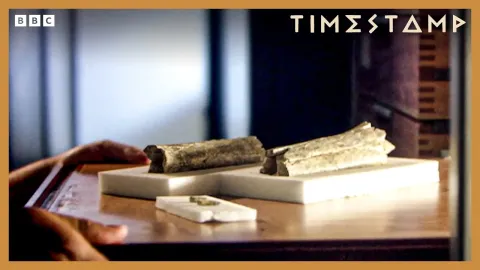


The most important building in the Roman Empire may never be fully excavated. Since the 1990s, archaeologists have known that the villa of the papyrie at Herculanium has two buried levels. These are likely to contain hundreds, perhaps thousands of carbonized scrolls, enough to transform our understanding of the ancient world on a scale not seen since the Renaissance. But because of the difficulties of clearing the site, there are no plans to continue digging. Many other remarkable Roman structures are known to wait underground, but are unlikely to ever be excavated. These are five of the most tantalizing.
Number five, the golden octagon. For centuries, Antioch, modern Antakia, Turkey, was the third largest city in the Roman Empire with a population that likely exceeded a quart million. Its monuments were famous. The colonated street illuminated at night that ran the length of the city. The temple of the nymphs ringed by fountains. The gladiatorial arena built by Julius Caesar. The imperial palace on an island in the Arantes River. Thanks to centuries of floods and catastrophic earthquakes, the ruins of Antioch are now up to 40 ft underground. The only systematic excavations ever undertaken, funded by a consortium of American and French institutions took place between 1932 and 1939.
These digs were complicated both by the depth of the ruins and by a der of funding which effectively forced the archaeologists to concentrate on recovering museumworthy mosaics. Only a few of Antioch's principal public buildings have even been located. And now, thanks to the growth of Antakia since the 1930s, virtually the entire ancient city is covered by modern development. The recent construction of the museum hotel, which exposed an entire Roman neighborhood, hints at the wealth of the treasures still buried. Of these, perhaps the most intriguing is the Golden Octagon. This was Antioch's Cathedral built by Constantine himself.
The huge octagonal church crowned by a towering dome was the center of an ecclesiastical complex that Constantine's biographer Ucius describes as richly adorned with a profusion of gold, bronze, and other costly materials. Constantine's church collapsed after an earthquake during the reign of Justinian. rebuilt. It was again destroyed by earthquake in 588 and never resurrected. If its ruins are ever discovered, they will open a new chapter in the study of early Christian architecture. That, however, is unlikely to happen anytime soon. Number four, the Caesar of Alexandria. With its great library, towering lighthouse, and cosmopolitan population of half a million, Alexandria was after Rome itself the classical world's
greatest city. Like Antioch, however, it has almost completely vanished. Alexandria dwindled to little more than a village under Ottoman rule. During the 19th century, an explosion of European investment made Alexandria a metropolis once more. Virtually the entire area of ancient city was covered and remains covered by apartments, hotels, and warehouses. In the midst of the building boom, Hinrich Schlean, the excavator of Troy and Mascini, came to Alexandria in search of Alexander's tomb. After a few exploratory trenches, he gave up. The ancient city was simply too difficult to access.
Excavation since then has been opportunistic. The catacombs of K Elshukva were discovered by accident at the turn of the 20th century. In 1960, clearance of a rubble mound, exposed the late Roman university and baths at K Elika, still the only place where modern visitors can walk the streets of ancient Alexandria. From the 1990s onward, underwater archaeologists revealed that part of the ancient harbor district lay submerged just offshore. The vast majority of the ancient city, however, is still hidden beneath the modern metropolis. The most famous lost building in Alexandria is the tomb of Alexander the Great, which I discuss in another video. But almost equally interesting in my
opinion is the Caesar. This temple dedicated to the deified Julius Caesar was surrounded by a vast colonated precinct that opened onto libraries, banqueting halls, groves, and courts. A pair of 200 ton obelisks from Helopoulos framed its entrance. The obelisks, which came to be known as Cleopatra's needles, remained in place until the 19th century, when one was moved to London and the other to New York. The colossal foundations of Caesar's Temple were briefly glimpsed in the late 19th century. The site, however, was then built over. Guests at the Hotel Metropole sleep directly above the ruins. Number three, the great palace of Constantinople.
The Ottoman sultans leveled many of Byzantine Constantinople's monuments. Mehmed the Conqueror demolished the church of the holy apostles, mausoleum of the emperors. Sullean the Magnificent pulled down the column of Justinian with its five times life-sized equestrian statue. The hippodromeome made way for the blue mosque. Parts of the great palace of Bzantium, however, still survive. The great palace was a sprawling complex of residences, reception halls, chapels, and gardens arrayed on terraces over the sea. It grew organically from the reign of Constantine to the fourth crusade.
Neglected and vandalized by the crusaders, it was ruinous by the time of the Ottoman conquest. One parasyle court probably built in the reign of Justinian has been excavated and opened to the public as the great palace mosaic museum. The facade of the seaside bukolian palace was recently restored. A section near Haga Sophia has been under intermittent excavation for years and many hotels in the Sultan Ahmed district have unofficial digs in their basement. But the oldest section of the great palace known as the Daphne Palace remains buried along with the main gate and the hall of the 19 couches where formal banquetss were staged. The Golden Hall, a domed octagon centered on a vast gilded table, is still
underground, as are all but a few fragments of the Magnora, sight of the Emperor's steamowered mechanical throne. Number two, the BS of Nero. Despite a century and a half of scientific excavation, most of ancient Rome is still and will always be buried. Even the locations of some of the city's most spectacular buildings, such as the temple of the deified Trajan and the temple of Juno Moneta, are unknown. Many others, though located, remain hidden. The most impressive might be the BS of Nero. Located near the Pantheon, the BS, later renovated by and renamed after Alexander Seis, remained in use until
late antiquity. Their opulence, long famous, is attested by the many fragments of the complex found and reused over the centuries. The most visible spolia are the three 40-foot columns of Egyptian granite on the left side of the Pantheon's portico inserted to replace the damaged originals in 1666. Two more columns from the baths have been set up nearby and a huge granite basin that likely stood in the calarium has become the modern Fontana delsenato. The baths themselves, however, have been covered since the Renaissance. Number one, the Villa of Lucalis. The mansions of the Roman elite have disappeared almost without a trace. Many were discovered and destroyed during the building campaigns of the late 19th
century. In 1879, for example, an aristocratic townhouse from the era of Augustus came to light in the gardens of the Villa Farnina. The fresco, the finest ever found in Rome, were removed. The rest was rearied. Among the most spectacular residences in Rome was that of Lucullis, the late Republican General Lissimo, who became fabulously wealthy from the proceeds of his eastern campaigns. Luculis constructed a villa and gardens on the slopes of the Pincian Hill. To judge from remains recorded in the 16th century, after which the area was built over, the villa was a raid on terraces cut into the hillside.
Lucullis entertained lavishly, and his villa was supplied with several dining rooms. In one of these, the Apollo room, Lucullis customarily gave banquetss, they cost 50,000 dinari at a time when the annual income of many Roman families was only 200 or 300 dinari. The villa's gardens, inspired by the paradises Lucullis had encountered in the east, eventually became a favorite retreat of the emperors. With the exception, however, of a few rooms preserved in basement, both the villa and its grounds lie hidden beneath the streets of modern Rome. Another ancient wonder that will probably never be excavated. Before you go, a quick announcement.
My third book, Leaky Aqueducts, Battle Pigeons, and Mystery Cults, is now available for pre-order. You'll find a link in the description. Check out my tour page linked in the description to learn about my upcoming trips. You'll also find links below to the Tolenstone Patreon, home to my Rome in review series. There are new podcast episodes on my Tolenstone footnotes channel and a series of new videos on sites in Spain and Turkey coming soon to Scenic Roots to the Past.
Enjoy and thanks for watching.