9:26



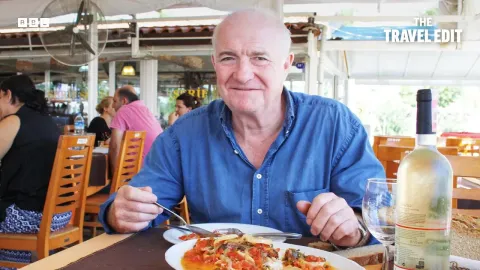
Well, I'm blowed. How are you? So good to see you. knew I was going to see you. You're in my neighborhood. Serhan, we filmed with him some time ago. I know him well. Exactly 7 years and 7 kilos ago. And 7 kilos ago. I know. Well, let's go off and find somewhere to have some lunch, I think. Okay. Serhan lives nearby and he took me to his favorite restaurant. It's right on the water and it specializes in fish.
The Queen Victoria was setting off and the film crew wondered if they were serving roast beef on board with Yorkshire puddings and horseradish sauce and maybe a pint of bitter. That's all they talk about. But fish is the order of the day here plus a rather surprising view of a seagull's undercarriage. Reminds me a bit of Padstow. This is a meze. It's from the Persian meaning a taste. A taste of lots of things. Well, to me the mezes are the real really special thing about Turkish cuisine and as you've seen there's a big tray. You just choose what you want. But here I've chosen some pickled bass with mustard sauce, pickled sea bass with
mustard sauce. Here I've got some green beans in tomato sauce which I always love. I love the way they cook them for a long time. Here we've got lacarda. Uh lacarda. Lacarda, which is bonito but it's pickled and served with red onion. Here we've got aubergine puree and Serhan says the quality of the aubergine puree really denotes how good the restaurant is. And finally one that I really wanted to try which is hamsi which is um anchovies that are pickled with lots of dill. And now we're ready to drink. Okay. Remember the etiquette, we say sherefe. Remember it's always courtesy to hit lower than your counterparts because everybody tries to do it. We lift the raki up. Higher. leaves some space so we can go down.
Sherefe. I've forgotten how nice it was. Uh welcome to Istanbul. Serhan, this is the end of what's turned out to be a long journey from Venice all the way to Istanbul. I'm so pleased to be here. The food is really good. Yes. Why do you think that is? Why is it so wonderful the food here? Rick, it's the melting pot. I mean, this city itself is the one of the most diverse places on the planet. And I'm talking about historically and even today. The diversity and cosmopolitanism. I mean, in the 15th century the under the Ottomans the Middle Eastern and the Central Asian influences came in. You know, the kebabs, the mezes and all the Middle Eastern Central influences blended with the local existing, let's say, Byzantine Greek
culture. Fish and the meze is maybe an outcome of that. And then under the Ottoman Empire there was incredible diversity and cosmopolitanism. Um the Jews who escaped from the Spanish Inquisition in 1492 were welcomed to Istanbul and they brought their own cultures. Some of the cookies, some of the bread names in Turkish language still today carry the Jewish names which they came brought from Spain.
Serhan, you know, the way you're speaking now, the way you just said that, I can imagine people watching the program thinking, I've got to go there on the internet going I've got to go and eat in Istanbul. I guarantee good food. Certainly. Sorry, should've been a bit lower. It's my last day and I haven't been inside Hagia Sophia or the Blue Mosque or the fabulous museum. There's so much to see and I feel a bit guilty. But mine's a food journey and the Sultan's home, the Topkapi Palace, housed his harem, his family, his guards, tutors, courtiers and cooks. 5,000 people in all. So the royal kitchens with their massive chimneys interested me very much indeed. And they've just recently opened to the public.
My friend Serhan, being a bit of a foodie, was the perfect guide. Amazing all these people here. Remember when I was young, we always went to the torture chamber. Now it's kitchens. All about food. It is. So Rick, we're under those chimneys now in the kitchens of the palace. This is where they cooked basically. You know, they had rooms, lots of rooms like this and these are the famous Ottoman cauldrons. Famous because they had a big role in the Ottoman history because the main elite troops, military force of the Ottoman army for centuries were the Janissaries. These were mercenaries. And once in every 3 months they had to get their salary from the Sultan. So the Sultan gave them a big
feast. And if they're not happy with their payment, they turned the cauldron over and they didn't eat the food and that's a very big trouble for the Sultan. eating this, taking it, eating it, is signing the contract. Exactly. So if the Janissaries were happy with the payment, here in this confectionery kitchen they cooked the candy called akide şekeri which literally means the contract candy. That means the contract is signed and sealed with a candy. I think we sort of tend to forget how important food is, not just for feeding yourself but in life and political life. I mean, the word salary comes from salt, payment in salt. And here we have the same thing, a little
candy for sealing the contract. Exactly. Fab.