53:47
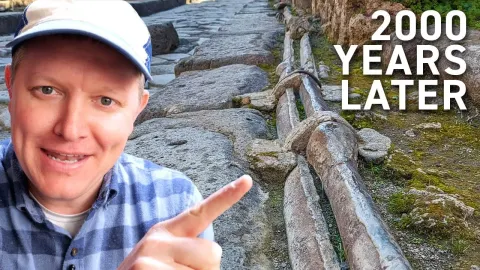


For a millennium, from Alexander to the Arab conquests, Egypt was part of the classical world. The most familiar artifacts from this era are the papyrie that shed so much light on daily life in antiquity. Less famous but almost equally remarkable are the thousands of Greek and Latin graffiti etched into Egypt's monuments. Grecoman graffiti are found from the catacombs of Alexandria to the legs of Ramsay's statues at Abu Simbel. But in this video, part of a collaboration with History for Granite, I'll be focusing on three iconic sites. the Valley of the Kings, the Colossus of Menon, and the Great Pyramid. In antiquity, the tombs in the Valley of the Kings, known in Greek as syringes, shepherd's pipes, were already tourist
destinations. Between the TMIC era and late antiquity, more than 2,000 Greek, Latin, and Coptic graffiti were inscribed inside the tombs. A single tomb KV9 made for Ramsy's V and sixth hosts nearly a thousand graffiti. Known to the Romans as the tomb of Menan, KV9 owed its popularity to the fact that it was large, beautifully painted, and located near the point at which tourists entered. Most of the graffiti in KB9 and the other tombs were close to the entrance, likely written as visitors were entering or leaving.
Like graffiti everywhere, they were meant to be seen and often placed high above the debriscovered floor. From a desire for a clean writing surface, or perhaps from some vague sense of respect, most writers avoided defacing the tomb's hieroglyphs. The majority of those who scratched graffiti in the Valley of the Kings wrote only their names. Some, however, also recorded their professions. Lawyers, philosophers, grimarians, and orators are attested, as are a legionary doctor, a professor of history, a composer of hymns, a high priest from Elusus, and a few of the guides who led visitors.
The graffiti writers came from every part of the classical world. Rome, Athens, Syria, Capidoshia. A few originated beyond the Roman frontier. Babylon, Arabia, and Persia are all mentioned. One late antique graffidito commemorates the visit of an Armenian prince. Instead of, or in addition to personal details, some graffiti record visitors responses to their surroundings. The dominant theme is wonder at the scale of the tombs, at the beauty of the paintings, at the arcane wisdom of their hieroglyphs.
One man says that his heart pounded with excitement. A few, however, were unimpressed. There is nothing remarkable here, reads one graffidito. The only thing I liked, claims another, was the sarcophagus. Yet another visitor complained about being unable to read the hieroglyphs. Who cares? Someone replied. A short distance from the Valley of the Kings stood the Colossus of Menon. This 700 ton statue and its twin were set up to guard the fenerary temple of Amenoteep III. By the Roman era, however, that temple had all but vanished. During the reign of Augustus, an earthquake cracked the Colossus, allowing moisture to penetrate its interior. Every morning dew escaping from the cracks made a sound like the
snapping of an otherworldly harpstring. Since the sound was only heard just after the sun rose, the statue came to be identified with Menon, mythical son of the dawn. For the next 200 years until Septimius Seis repaired the statue, inadvertently closing the cracks that made it sing, the Colossus of Menon was a major tourist destination. No fewer than 107 graffiti, 61 Greek, 45 Latin, one both, were inscribed on its legs and feet. As in the belly of the kings, the graffiti occupied highly visible places. The right leg of the colossus was covered before the left, probably because it was better illuminated by the rising sun, the light in which other visitors would see it.
The inscriptions also tended to cluster by age. All the graffiti relating to Hrien's visit, for example, were located on the left foot. Hadrien came to hear the Colossus on November 20th and 21st, 1:30, an occasion commemorated by six Greek epigs on the statue. Nine prefects, Roman governors of Egypt, left graffiti. So did a handful of local officials and legionary officers. Some dignitaries brought poets with them responsible for producing verses that would be inscribed on the statue. 39 poems, almost all in Greek, were carved into the Colossus. A fairly typical example was composed by a certain Aras
who describes himself as a homeriic poet. What a wonder my eyes behold. One of the gods, a lord of the celestial plain must be within. to have uttered the cry that holds the world captive. No mortal creature could produce such a marvel. All four lines were taken from the Iliad. A nice way of showcasing Aras's expertise. Although most of the other poems on the Colossus are longer, their basic meaning is almost always I came and witnessed a miracle. Before we go on to explore the graffiti on the Great Pyramid, a brief word about this video's sponsor. Mindless scrolling. We all do it and we all hate it. If you want to break the habit, try Mind Snap, an app designed to help you learn something meaningful in just minutes.
Once you select topics you're curious about, the app creates a curated list of lessons, quizzes, and articles tailored to your interests. Here, for example, I'm reading the lesson on Aristotle. At the end of each lesson is a summary and a short quiz to reinforce what you just learned. It's fun, it's straightforward, and it works. There's a huge range of topics to choose from and peique your curiosity. So, stop scrolling and start learning with Mind Snap. Follow the link in the description to start today. Returning to our topic, the Great Pyramid once had a collection of Greek and Latin graffiti to rival that on the Colossus. Although these disappeared with the casing stones in the Middle Ages, two
were preserved in textual sources. One was a short Greek epig. I, Maximus, saw and pondered the monuments of Kefin, godlike Myerinus, and Kops. In other words, the Giza pyramids. The other classical graffido known to have been inscribed on the Great Pyramid is a Latin poem recorded by two medieval travelers. I saw the pyramids without you, dearest brother, and poured forth such tears as I could for you here. To enshrine our grief, I inscribe this lament. Let the lofty pyramid know the name of Desimus Gentianus, a ponte effects and companion of Trajan's triumphs who served within six lustrations as both console and sensor.
Desimus Torrentius Gentianis a prominent senator held all the offices available to a man of his rank. Decorated for bravery during the Dian wars, he led a legion in Trajan's Parthion expedition. Hadrien is said to have considered naming him his successor. Gentianis's sister Torrentia, the author of the epig on the Great Pyramid, likely accompanied Hadrien when he visited Egypt in 130. Her poem claiming that the fame of Gentianis deserved to equal the pyramids recalled a famous boast by the poet Horus. I have made a monument more lasting than bronze and loftier than the regal pyramids.
The sentiment of her epig likewise echoed the final lines of the poet Catalysis's lament for his brother who died far from Rome. Receive now these mournful writes transmitted by ancient custom freshly bathed in fraternal tears and forever brother hail and farewell. The stone on which Trentia wrote is gone, but her words endure. To learn more about the Great Pyramids graffiti, check out History for Granite's video linked on screen and in the description. Although the tour I'm leading to Egypt this November is now full. You can follow the links in the description to learn more about my other upcoming tours.
You'll also find a link there to the Tolenstone Patreon, which hosts Rome in review, a series exploring movies and shows set in the ancient world. There's a new podcast interview about the Bronze Age Collapse featuring Professor Eric Klene on the Tolenstone footnotes channel. Finally, on my travel channel, Scenic Roots to the Past, I'm finishing a series on the archaeological sites of Greece with two videos on Cree. Please check them out and thanks for watching.