


2:31


Commercial vessels under attack. The blockades by the US and Iran in the straight of Hammuz are disrupting global trade. The crisis highlights the danger conflicts and territorial disputes pose to shipping. Why are maritime laws failing to secure the seas? This is Inside Story. Hello again. I'm James Bays. Wars and territorial disputes are rewriting the rules of global shipping. From the Strait of Hum to the Panama Canal, from the Red Sea to the Black Sea, maritime traffic is under increasing threat. The UN says global trade growth is expected to slow from about 4.7% in 2025 to less than 2 and a.5% this year. There's also the danger posed by pirates. Last year, the number of piracy incidents rose to its highest in five
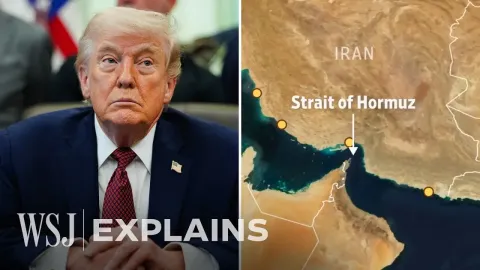
years, according to the International Maritime Bureau. So, is shipping becoming the new global battleground? Why are the decades old laws governing the sea failing? We'll discuss all of this with our guests when they join us in a moment. But first, this report by Ferdier Carr. The waters of the straight of Hormuz may appear calm, but they are a front line in the war between the US and Iran. There is no permission for you from the straight your order to go back to your departure immediately. Iran's restrictions on shipping and the US blockade of Iranian ports have effectively closed the crucial maritime trade route. It's one of several
waterways where freedom of navigation is at risk. Though the principle is older, freedom of navigation became international law in 1982 with the UN Convention on the Laws of the Sea. It states that ships can't be impeded in international and territorial waters as long as their passage is peaceful. Those rules have maintained a system of free flowing global trade which has grown from about $60 billion in the 1950s to more than $25 trillion last year. According to the World Trade Organization, the UN has warned that prosperity is under threat. Navigational rights and freedoms must be restored immediately. Open the straight.
Let all ships pass. Let the global economy breed again. Though not a signatory, the US has long seen itself as a guarantor of that principle. It's led antipiriracy patrols in the Indian Ocean since 2009 and carried out strikes against Houthis in the Red Sea in 2024 and 2025 when the Yemeni armed group attacked ships it said were linked to Israel in response to Israel's war on Gaza. More recently, the Revolutionary Guard warned it could close the Babel Mandup Strait, a choke point leading to the Sewish Canal after President Donald Trump said American forces would destroy Iranian power plants.
The US is also accused of violating freedom of navigation by imposing a blockade on ships entering or leaving Iranian ports as is Tehran for its attacks on vessels in the Straight of Hormuz and for drafting a law which would see a charge toll fees for safe passage. Since 2022, both Russia and Ukraine have bombed each other's vessels in the Black Sea. And it's not just international waterways. Tensions between the US and China over the Panama Canal have escalated during Trump's second term. Washington accused Beijing of violating Panama's sovereignty by detaining two of its vessels, while China accuses the US of hypocrisy, citing Trump's comments about taking back the canal. Who is coveting the Panama Canal, attempting to turn what should be a
permanently neutral international waterway into its own private channel while disregarding the sovereignty of countries in the region? The answer is self-evident. With maritime laws undermined, there are fears that the ease of trade on which the global economy depends could also be threatened. Freddy Aar Alazer for inside story. So a complex subject, but we have the right guests to make sense of it on today's insight story. Joining us from Medford in Massachusetts, Rockford Vites. He is director of the Fletcher maritime studies program at Tus University. George Theodoris is in Malmo in Sweden.
He's a professor of maritime law and policy at the world maritime university. And in Cavala in Greece is Stavros Karampedis, an associate professor in maritime economics at Plymouth University. So we have an expert in the law, an expert in the economy, and an expert in the security situation. Let's start with you then, Rockford. Security is your area. How bad is the state of maritime security? Well, it's uh it's definitely not good. Uh 2026 has not been a good year for maritime security. As we've seen, it's truly a global phenomenon from uh what we saw in Venezuela in the Caribbean. uh that we've had issues in the Red Sea
with the Houthies and now in the street of Hormuz and continued tensions in the South China Sea and Taiwan Strait. So I would say it's under tremendous pressure. Stavros, I mean let's just start with the story that is um dominating and has been dominating the news uh across the world now um for a couple of months which is the war in Iran. And what is interesting about this is that a conflict that started um with the nuclear issue and the fear of nuclear war, it seems now a waterway is a more potent weapon uh than a nuclear warhead. Thank you very much for having me, James. And uh to be frank, yes, I think that's the $1 billion question that
you're just asking. uh which it seems that we underestimated in the global sphere the importance of shipping and um shipping as we constantly say is the backbone of the global economy and uh every anyone who is able to control that is able kind of control where the global economy goes. So I think what we're seeing in the straight of hormones at the moment is um exactly what you describe is like people are trying to project their power according to uh where they want the economy to go and uh I wouldn't equivalent it to a nuclear warhead but definitely can make a huge damage and we see some damage happening already in the global economy because of the closure of the state of hormones. So
I think we should look at in cautious and uh see how the things will evolve. George, there are supposed to be laws. We'll come into more detail of what those laws are, but Iran um is or has been uh running the street of Hormuz um as though it's a toll booth. Um that's against international law. And it's not just Iran now. Um the US with its own blockade. And of course, it was the US uh that started along with Israel this war. Many say in breach of uh the UN charter. Well, f first let me start by thanking you for having me here. It's um it's a very complicated issue and I will try to keep it uh as simple as possible. Um indeed we have uh rules uh we have uh primarily the uh United Nations
Convention of the Law of the Sea which was shown earlier uh which to a certain extent has codified previous customary rules. Now, interestingly, both belligerent states uh albeit in ceasefire at the moment, they have not ratified the convention. They've only signed a convention. Therefore, they're not bound in the strict sense. However, they're bound by international and international customary law. So, the question is whether those acts really are infringing uh the system that we have. Well, I'm I'm going to say that at the moment the global system of my time governance that
we have is under a huge pressure. Now, if you make legislation which is very detailed, the states are very suffocated, they feel suffocated, they will not ratify it. If you get too much freedom and you ask really for the states to act responsibly, then you have what you call the gray areas where the agitators, the perpetrators can commit certain acts. At the moment we have an unprecedented really double blockade and of course the most significant uh um repercussion at the moment apart of course from the uh legal dimension is the fact that um navigation freedom of navigation which is a sacrosant rule has been really at the moment under tremendous pressure. So um just to keep
it simple um I think at the moment the rules uh are being under a lot of pressure. So the law isn't working, the economy of it not working and the security situation is not working. Uh let's I think go back and explain what's at stake with all of this and how global uh shipping works. And I mean I was doing the research on this. You all know this but I didn't. There's a very important date. a date that some say changed the world and it's not one that was in my mind. The 26th of April 1956. That's when a man called Malcolm Mlan, a trucking entrepreneur uh from North Carolina loaded truck bodies, aluminium truck body bodies on a World War II uh tanker. Took 5 days for them to go from
Newark, New Jersey to Houston, Texas. And that was the first containership in essence. Um perhaps you can tell us Stavros about containerization and how it completely revolutionized the world. Yes. And the name of the vessel was the ideal X which is you know the mother vessel of everything else that was built on it. Uh you're absolutely right. Since the birth of conerization, transportation become cheaper. Thanks to Malcolm Mlean, we managed to see how we can reduce inefficiencies. And since then, uh the overall logistics operations, they're always trying to reduce inefficiency in the system. So
that's why we managed to have a very efficient system because of shipping. That's why shipping is carrying approximately 85% of the global trade uh in terms of volume because it's cheap, reliable and uh resilient. And the thing is that you know I can give you some very bold figures. You know everybody's talking about for example uh the cost of oil and all that kind of stuff. Before the crisis transferring with a VCC a barrel of oil was 0.03 US. you know, we're talking about a fraction of it now because of what is happening because of the increased insurance cost, because of all the other issues, the increased freight rates that we are hearing left, right, and center, that has increased 10fold. And of
course, now we're talking about 0.3 uh US dollars per day, which if you consider that every vessel takes a lot of time to go from point A to point B, that adds a lot to the overall um transportation cost. So uh thankfully as we said we managed with shipping to be able to fuel globalization because it was very cheap and reliable. Unfortunately with what George was mentioned a minute ago is that is under question. Stros what I find interesting is that this is a sort of invisible infrastructure. None of us think about it. How we get stuff how the food arrives how the fuel arrives. But this goes on and has gone on for decades. this global uh supply chain um
by ships and it affects everyone not just the rich people in society. If you're living in a tent um some of the aid deliveries and food will be coming by shipping. That's totally correct James and you know we have approximately 100,000 vessels operating around the globe. You know we hit the we heard in the news several times that there are 20,000 sailors have been trapped in the straight of Hormuz because of the overall situation. You know there are thousands and millions of people operating into the maritime sector and we're very pleased to say that you know we were doing that for many years without attracting any of attention because we're very reliable and very cost effective on what shipping is doing
and is able to do but as you rightly said what is happening now it has a knock on effect to everybody because you know the simplest thing you have to consider you know when the oil price goes up that means that the bankers the fuel cost that the vessels are paying is increasing. I can give you an example. Before the war, it was approximately $480 US per ton. Now we're talking about nearly 900. So you know nearly double up the amount of fuel cost that is required for move the vessels. So as you can imagine all those costs have been accumulated in the overall operations of the vessel and of course that will pass to the final customer because someone will have to pay for that. Rockford. I mean, there's
also what's called the just in time economy, making things um including fresh produce arrive just when it is uh needed. Um all of this though um has created a fragility, has it not? Which is now being exploited. We saw it in COVID 19, but now it's being exploited by bad actors. This is correct. Yeah. And thank you also for having me. It's great to be here. Uh so you're absolutely right about that what we saw uh really co 19 was the first peacetime global disruption of trade and we saw all kinds of vulnerabilities. It's kind of hard to imagine that was 6 years ago and there have been efforts to try to increase resilience in the system and do some what's called reshoring uh locally
for larger countries like the United States or regionally in Europe or North America for example. But as we have witnessed uh over the last 2 months, uh just one critical maritime choke point being blocked for an extended period has all kinds of second and third order effects. And so we're seeing it not just with hydrocarbons, with liqufied natural gas, crude oil, but also fertilizer, helium, food coming in. Uh aid is actually avoiding even the Red Sea. So it's going from India all the way around Africa through straight to Jibralter and Sewish Canal to get to Port Sudan for Sudan. This is uh this really is uh I would say it's it's not unprecedented uh in history but it is unprecedented
since the end of World War II. So during this the sort of uh peaceful rise of globalization and certainly since the age of containerization was launched by Malcolm McCann in the 50s. So uh in that case uh this the whole system is under pressure uh and we're seeing it regionally and globally. So um George I mean mentioned there from Rockford of these problem areas choke points bottlenecks in the system and my understanding is they don't all have the same legal basis. The sewis canal is not the same as the straight of hummus for example. That is absolutely right. Um indeed um the law of the sea has made a very clear distinction uh of the different areas and of course the different rules that apply. Let me just say at this point
that the legislature I'm talking about the UNCLOS has very sorry I'm going to interrupt you there unclos just tell me what that is to be absolutely clear what that UN love their acronyms tell me what UNCCLOSS is sorry I mentioned it earlier it was actually shown on the video United Nations Convention of the Law of the Sea. Yeah. uh which is what we call the constitution of the oceans because of the large number of ratifications that it has. So the legislature has very clearly made uh differences and different legal treatment uh about the different waters. So in the uh case of a straight uh there are certain rights which can be exercised apart of course from the right of navigation we also have the right of transit passage and
again the legislation uh it's very clear no duties no charges are supposed to be imposed unless there is a service. So in the case of Pan Panama Canal or Suez Canal where you have installations uh infrastructure and therefore expenses and some service is actually is being paid then in that case that is perfectly justified. But in the case of Straits, this is really uh not a gray area, but something that I would venture to say will bring us back to the dark ages where we were trying to convince as an international legal community that we should have freedom of navigations. Back at that time in the 17th century there were assertions by the m big nations at that time marime nations like Spain and Portugal that you know that there should be
exclusive sovereign rights in the seas and that of course was linked at that time again with the trade lanes. So we move from that yet with these kinds of actions I see that we're trying in a way to bring back from a backdoor something which we would expect that it's out of any discussion. Let's bring in Stavros and talk about um piracy and people think of the image of a pirate with the tricorn hat and the cutless and the Jolly Rodger flag. Tell us about piracy in the modern world. In the modern world, pirates are very sophisticated. uh they have specialized uh sections how they operate and we've done recently a work on that uh on what is happen of the Gulf of Guinea and how the pirates are operating over there but
what we're seeing now at the moment is that unfortunately because of a lot of naval forces been um in the area of the Gulf in the Persian Gulf there is uh a lot of activity in other places that was forgotten about so a lot of pirates because of the previously They used to be a lot of naval operations taking place in other parts of the globe and now they've been repositioned either back in Europe for protecting the European continents or coming into Mediterranean or in the Middle East. Uh that's why they found a opportunity gaps let's call them that way uh that they were able to go out and um do what they used to do for a couple of years ago. And uh unfortunately that's not a good scenario because uh as you know there's not
unlimited amount of naval power out there and of course I'm sure Rockford will tell us a bit more on that. Uh but uh because we have limited amount of naval forces at the moment we could probably imagine what will happen if those naval forces are being deployed in specific areas that piracy will start merging up again in areas that we've seen that has kind of clearly closely to elimination. They were closely eliminated those years. Well, let me ask you, Rockford, about those naval forces, and I think it's interesting. You don't have to go back that far. Uh 2009, the UN Security Council was unanimous on this issue. It was about Somali uh pirates at the time. They um formed
something called combined task force 151 and it was supported by all the five permanent members of the security council deploying naval forces on the same side. We're in a different world now, aren't we? Yes, we are. I cover this in both my maritime geopolitics class and my law of the sea class because it is important to distinguish piracy from non-state armed groups like the Houthies that aren't that are really engaged in kind of asymmetric warfare. So let me try to unpack it. So what really has what that what you were referring to back in 2009 was the assembly of the greatest most powerful maritime coalition in history. It included NATO. and included
Japan and China. It included even Iran contributed to it as well as India and Pakistan. So you can imagine uh the essentially everyone could unify and the international law against piracy is quite clear and not controversial but everyone could unify against the Somali pirates and there were no permanent members of the UN Security Council that would get in the way of a UN Security Council resolution. So it was much easier to assemble a maritime coalition back in on that maritime challenge. What we're seeing unfold today is different because uh Russia in particular uh is willing to get in the way of a UN Security Council resolution. Bahrain has tried to do that. Uh but Russia
actually likes these high oil prices. So uh they're they're not eager for this to be resolved. China's actually different. And I think China uh is actually at this point uh eager for both the US blockade and the disruptions in the straight of Hormuz by the Islamic Revolutionary Guard core navy to dissipate and move on. Um and so fundamentally the other issue I'll mention is last point is what we've also seen is the rise of drone warfare. This really started in the Black Sea where the Ukrainians who don't have a navy essentially defeated the Russian Black Sea navy and even sunk its flag flagship the Moskva. And then we saw the Houthis take similar technology uh drones and then also they were the first non-state
armed group to launch an anti-hship ballistic missile uh and they did that after October 7th disrupting commercial shipping through the Bob al-Mandde and the Red Sea. Uh and that commercial shipping is never actually fully returned. And then we see the IRGC, the Islamic Revolutionary Guard Corps around the street of Hormuz use small boats, fiber optic drones that can't be uh jammed, and then of course anti-hship missiles. And so fundamentally in some what we're seeing here is the international maritime law regime is under pressure from new technology where geography like the straight of Hormuz can be used for what's called asymmetric warfare. So using uh relatively cheap technologies like drones to disrupt
commercial shipping and put navies kind of uh push the navies back into deeper waters. The navies can go through but they risk uh casualties or damage to their ships. So happy. So let me bring in um uh George on some of those points. Is this not just the maritime dimension of what we're seeing elsewhere, which is everyone has stopped abiding by the rules that were there since World War II? And what is that going to mean for international shipping if we go back to, you know, much more ancient times yet with much more sophisticated um weaponry? Well, um this is really a crucial question. This is really the core of the matter. I'd like to echo what was said earlier by both of my colleagues and
and what I said earlier about the global system of maritime governance or ocean against the backdrop that we had uh which was really the uh international law customary law but also the UN charter postc world war. It seems that at the moment the model which was structured again at that time with the five members of the security council and the unonymity which is required this is again under pressure and it seems that unless the rules of the game if I could use that expression to a certain extent either are respected or somehow we find an amendment uh coming forward uh we will have the same problems. Um we saw that where as it was said earlier in 2009 there was absolute unonymity all the international community was uh on
that particular matter on the same ground. At the moment we see that whenever um and also in other uh areas whenever there is an attempt really uh to pass a resolution one of the members of the security council is blocking it which of course tests again the limits of our system. The system which as I said earlier is the one that ensures that we have the supply chain in place. We have freedom of navigation. Let me bring in Stavos at the end and just I mean there is a risk of widening war around the world but if we're just talking about disruption who is paying the price of this I assume it's all of us.
That's absolutely right is everybody. And we have to consider that shipping for example is responsible for carrying uh several billion tons of cargo. Just to remind you for example that the value of a vessel as we're talking a minute ago about piracy a value of a vessel approximately is 150 million for one vessel and you have to consider that some of them they have couple of billions on top of that in terms of value of cargo. So it makes sense that first of all the pirates want to get hold of them and also whatever is happening in the region everybody wants to use shipping as a bargaining chip because there is a lot of power in terms of economics on it. You know, it cost a lot of money to move stuff around the
globe and everything has been loaded on vessels. Stavros, Karan Paredis, George Theois, and Rockford Vice, thank you for joining us on today's inside story. If you missed any of this fascinating discussion, don't worry, you can watch the program again anytime you want at algazero.com. What did you think of this topic? You can post on our Facebook page, facebook.com/abj inside story, or join the conversation on X. There you'll find us at AJ inside story. For now, that's it from me, James Ba, and the team here. But of course, it's not it from Al Jazer. Coverage continues around the clock. Stand by for an update in just a moment.

Read the full English subtitles of this video, line by line.