
5:28


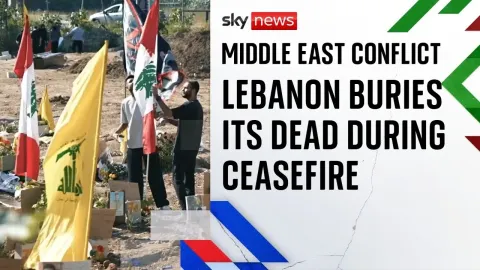
We had this week in Washington real direct negotiations between Israeli and Lebanese representatives. This is the first time where two countries are sitting together for over three decades. Let's feel the moment. Let's enjoy the moment. From what we hear The atmosphere was it was positive, And Trump says Israel and Lebanon have now agreed to a ten day cease fire. isn't Lebanon have a shared interest in there being a ceasefire at least the mainstream, in both countries want there to be a ceasefire, want there to be, better type of relations between the two countries and perhaps most crucially, want Hezbollah.
No longer to have, its role as an armed militia deciding when it wants to, attack both within Lebanon and, and against Israel and they also don't want Iran to be able to dictate, Hezbollah moves. Israel has been carrying out airstrikes on Hezbollah targets throughout Lebanon. Around a million Lebanese civilians have been uprooted by the strikes. Hezbollah has fired missiles and drones at towns in northern Israel. And there's also fighting on the ground near the border between Israel and Hezbollah fighters. both countries have an interest in decoupling what is happening, in Israel and Lebanon from the
the other conflict, the much bigger conflict that's happening with Iran. But the problem is, is that Iran has had this influence over Lebanon, through Hezbollah for so many decades, Iran sending wants that to be a connection. They've demanded that as part of the wider ceasefire between them and America, that also there'll be a ceasefire in Lebanon. So while the Lebanese want a ceasefire, they also would prefer it not to be connected to what's happening in Iran. Israel's offensive in Lebanon has been underway for several weeks now. What is its strategy? Well, that really depends on who you speak to on the Israeli side.
Diplomats and some security officials say that the main thing is to weaken Hezbollah and to create some kind of cooperation with Lebanon, where the Lebanese army will, undertake the disarming of Hezbollah. Other people that you talk to. And Israel's more hard, right politicians, and at least some military officials talk of a much more long term Israeli occupation of a swathe of land in southern Lebanon, a security zone which will remain under Israeli military control and depopulated for the foreseeable future to prevent Hezbollah attacking. these are two different strategies, and I'm hearing both of them all the time in the region in recent weeks from Israeli officials.
And what about Lebanon, which continues to be in this very awkward situation with Hezbollah? Well, Lebanon would like to deliver what Israel is demanding, the disarmament of Hezbollah. But the Lebanese army currently is simply much too weak. Hezbollah is a stronger, better organized, better armed fighting force. And they've also been threatening to carry out a violent coup in Lebanon and Iran, which is supporting, Hezbollah doesn't want to lose its proxy, doesn't want to lose its control over the country. so Lebanon is in a bit of a bind here. As you mentioned, Trump has just talked about direct talks, and this week's discussion between Lebanon and Israel
were mediated by the US Secretary of State, Marco Rubio. So what is America's role? So America certainly can bring the sides together. America has the resources to help the Lebanese army to build up its capabilities. But it probably won't happen overnight, but to build up a capability to take on Hezbollah eventually. But at the same time, America and certainly Donald Trump has a much bigger interest in that in achieving a permanent ceasefire with Iran. And that's why he's more amenable to Iran's demands that Lebanon also be included. So America sort of is playing two roles here.
It's it has its more immediate, influence on bringing the sides together, but it also is looking at what's happening in Iran and thinking. Is Lebanon part of the package or can we deal with Lebanon separately? And it doesn't seem yet that there's a clear idea in Washington about how to go forward with that. What will happen next in the coming weeks, do you think? Netanyahu, both for, domestic political reasons and I think also for diplomatic leverage, on, but to come up on you now, tell He wants to see some more concrete proposals
coming from Lebanon about how they plan to disarm Hezbollah. And he also wants to extract from them some kind of a commitment towards a full diplomatic relations with Israel in the future. Now, for the Lebanese, It's much more urgent to get a longer term peace deal. being forced out of their homes. They've got the prospect of sectarian violence now because these are mainly the Shia community and other communities in Lebanon is kind of blaming them and saying, you know, you brought this upon us. The Israelis are attacking us because, of your Hezbollah, attacking them. So the Lebanese need to defuse this situation as soon as possible.
And that's where the Israeli and Israeli and Lebanese interests differ. They think both countries would like to see that out of the equation after the equation. But the sequence of how to make that happen is different from either country. And so thank you very much for talking to me. Thank you for having me, Rosie.
Read the full English subtitles of this video, line by line.