11:49



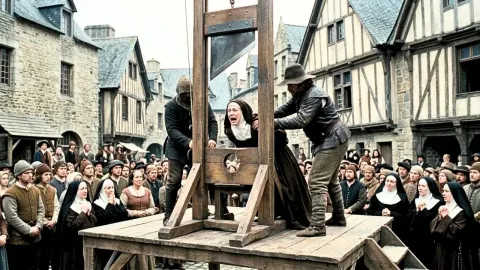
The most terrifying sound in a 17th century town square wasn't the roar of the mob. It was the heavy metallic click of an iron cage locking into place. In the center of the clearing, a woman stands perfectly still. She isn't screaming because she can't. A jagged metal plate is pinned against her tongue. One wrong move, one sob, even one attempt to swallow, and the iron teeth puncture her flesh. The crowd isn't looking away in horror. They're leaning in, laughing, and tossing rotted fruit while children point at her frozen face. This wasn't a secret act of cruelty. It was a legal public correction. Her crime. She was accused of talking too much. That is where this
story begins. Not in a dungeon, not in a chamber hidden from polite society, but in the open air, in front of witnesses, in full daylight. And that detail changes everything. Before we go deeper into these shadows, drop a comment right now and tell me where in the world you're watching from. I never stop being amazed that stories buried this deep in history somehow find their way to people everywhere. This is Europe broadly between the 14th and 18th centuries, though the timeline stretches further than most history books admit. These were the centuries of the Inquisition, the witch panic, and what historians now call a systematic architecture of female control.
It wasn't random cruelty. It was engineered, documented, codified into law. Judges signed orders. Priests gave blessings. Crowds gathered on schedule. The devices themselves survive. Many of them sit behind museum glass today in Edinburgh, Nuremberg, and Madrid. They are small in some micas delicate almost. And that is what makes them so deeply unsettling that a thing capable of such damage could be assembled by an ordinary craftsman carried in a leather sack and handed over like a key. Historians have cataloged hundreds of instruments designed specifically for use on women's bodies and specifically for use in
public because public was the point. The suffering had to be witnessed. The lesson had to land. What drove the men who built and used these tools? Some believed they were saving souls. Some believed they were enforcing divine order. and some, as the records quietly confirm, were simply men who had been accused of something by a woman they wanted silenced forever. That is the paradox that runs through every chapter of this history. The instruments of so-called justice were, in Manikas, instruments of revenge, dressed in the language of God. The device locked around that woman's head in the town square had a name. It was called a scold's bridal, or in Scotland, a branks. It was designed in the 16th
century and used with remarkable regularity across Scotland, England, and parts of Germany well into the 1800s. The construction varied. Some were elaborate iron helmets covering the full skull, others simple cage frames, but every version shared the same key feature, a metal plate, sometimes spiked, sometimes flat and broad that pressed into the tongue the moment the wearer tried to move her jaw. Women were fitted with it for offenses that wouldn't warrant a raised eyebrow today. Gossiping, arguing with a husband, accusing a clergyman of misconduct. Speaking publicly in a dispute, the legal category was scolding a crime that existed only four women. No man in English legal history was ever sentenced to the scold's bridal, not once.
The records are clear on that point. What the records also reveal, and what almost no one discusses, is this. Many of the bridles were fitted with small bells, not to warn Pasurby. Not as an accident of design, the bells were attached deliberately so that when the woman was led through the streets, everyone with an earshot would hear her coming and come out to watch. The humiliation was a community production. The suffering required an audience. In Dundee in 1654, a woman named Janet Irvine wore the bridal for three consecutive days after she argued with a church elder who had publicly humiliated her daughter three days with iron
pressing into her tongue. She could not eat. She could not speak a single word in her own defense. Court records note that she was released on a Sunday morning and that she never spoke clearly again. No appeal was filed. No official expressed regret. The same elder who had her fitted with the device was still presiding over Sunday services the following week. History rarely asks what Janet Irvine was thinking about in those three days. It only records what was done to her. If the scold's bridal controlled women through silence and spectacle, the ducking stool controlled them through something older and more primal, the terror of drowning. It was a wooden chair mounted on a long beam. The
woman strapped into it. The beam extended out over a river or pond, then tipped down she went. Cold water, darkness, choking, then up, gasping, wretching, while the crowd on the bank counted, then down again. In Leicester in 1731, a woman named Jenny Pipes became one of the last documented victims of public ducking in England. She was accused of scolding and troubling her neighbors. The local magistrate ordered she be ducked four times. An eyewitness account preserved in parish records noted that by the fourth immersion she had stopped struggling. The crowd cheered. She survived barely. The magistrate recorded the session as a success. But the ducking stool had a darker logic embedded in its design. One borrowed directly from the witch trials. If a
woman floated if her body refused to sink, she was considered guilty of witchcraft because only the devil's compact could make human flesh. Buoyant. If she sank and drowned, she was innocent. Proven innocent at the cost of her life. The test had no outcome that saved her. Both paths led to death or devastation. It was not a method of finding truth. It was a method of guaranteeing a predetermined conclusion. Hundreds of women across England, Scotland, and colonial America passed through versions of this ritual between 1600 and 1800. Many did not survive.
Those who did were rarely recorded as having received any form of compensation or acknowledgement of innocence. They simply disappeared from the documents which is its own kind of eraser. Now consider what happened before the ducking stool before the public humiliation in the interrogation rooms where the accusations were formalized. This is where the third great architecture of female torture operated. Quieter and more insidious than anything in the town square, which prickers were professional examiners, mostly men, hired by courts across Scotland, England, and Germany, whose job was to identify the devil's mark on a woman's
body. These marks could be anything. A birthark, a scar, a mole, even a patch of skin that seemed less sensitive than the surrounding area. The accused were stripped completely naked, examined in front of male officials, and then stabbed with long needles across their bodies, their shoulders, thighs, breasts, and lower abdomen in search of a spot that did not bleed or cause pain. A numb or bloodless spot was considered conclusive evidence of a satanic pact. What the courts did not disclose. What was never announced to the women being examined or the families watching was that many of the needles used by
these prickers were retractable. The blade disappeared into the handle on contact. The woman appeared not to bleed because there was no blade. The pricker could manufacture guilt on command and he was paid per conviction. A Scottish pricker named Johnqincaid was eventually exposed in 1662 after it was discovered he had been using a trick needle. Awas fine. He was not imprisoned. He was not executed. He simply retired. The women he sent to death had no such luxury of outcome. And that leads us to a name that history almost forgot but shouldn't have. Anaglier. Her story is perhaps the most haunting of all because of when it happened. By 1782, the European Enlightenment was in full bloom. Voltater had been dead for
four years. The American Constitution was being drafted. rational inquire, the rights of the individual and the skepticism of superstition. These ideas were circulating through the educated classes of Europe with urgent momentum. In Tisworld, in the canton of Glaris in Switzerland, a quadantis domestic servant named Anna Gllay was accused of bewitching her employer's daughter who had begun suffering mysterious convulsions. Anna was arrested and broken not by the rack, but by the relentless grind of sleep deprivation and stress positions. In her exhausted delirium, she confessed to a fever dream, giving a child poisoned
milk on the instructions of the devil. On June 13th, 1782, Anna Geli was publicly beheaded in Glaris, Switzerland. She died as the last person executed for witchcraft in central Europe. It's a chilling timeline. She didn't perish in some forgotten medieval backwater. She died in the age of Mozart, the Declaration of Independence, and the dawn of the modern world. Enlightenment, it turns out, was a luxury that didn't extend to everyone. Her employer, the man she served, and the man who had been having an affair with her, provided the testimony that killed her to keep his own secrets buried. He lived to old age in comfort, while her blood soaked the town square.
Then there is the breast ripper. The name alone is enough to make you recoil. This was a handheld iron claw heated until it glowed and used tear flesh. It was a weapon of the Inquisition and which trials across Germany, France, and Spain. Reserved for women accused of adultery or infanticide. The court manuscripts from Nuremberg record these devices with the cold precision of a hardware inventory. It was a punishment gendered by design, codified in law. Some women were left alive, not out of mercy, but so their scarred bodies could serve as a living, breathing warning to the rest of the community. This architecture of violence, the bridles, the stools, the needles, and the claws
didn't just vanish. It embedded a precedent that a woman's body was a legitimate site for public correction. If she spoke to boldly or accused the wrong man, she could be subjected to engineered humiliation with full legal sanction. In the National Museum of Scotland, a 17th century scolds bridal sits behind glass. A placard beside it reads, "Used to control women deemed troublesome." 11 words. That's all that remains of the woman who wore it. No name, no record of what she said, no mention of how long she suffered. History tends to preserve the paperwork of the powerful, their budgets, their decrees, their receipts.
We have the ledger showing a blacksmith was paid to silver coins to forge a device for female correction. The transaction took less than a day, but the device lasted decades. That is the most disturbing truth of all. This wasn't chaos. It was a system. It was organized, funded, and scheduled. The machines of eraser survived, while the women they were built to silence did not. They recorded the tool and they erased the human. They called it justice and they made sure everyone watched.