10:47
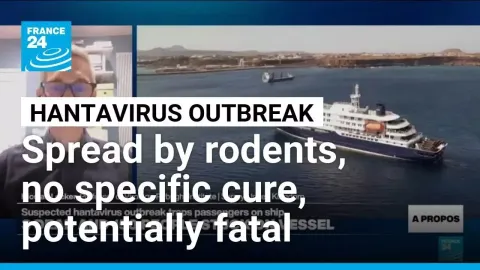


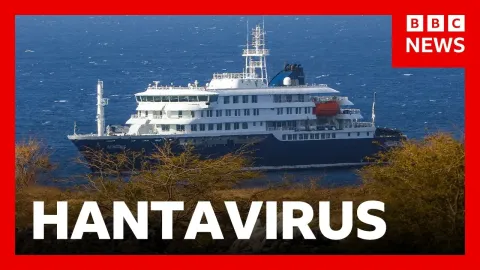
The cruise ship hit by a rare outbreak of the Hunter virus will set sail for the Canary Islands. The 1500 kilometer journey from Cape Verde Islands will take 3 to four days. Spain has granted permission for the ship to dock in Tenneref on Saturday. That's despite the objections of the island's regional leader. Now, in just a moment, we'll get a risk assessment from the World's Health Organization. But first, here's an update on the stricken ship. The world's eyes are on this scene. A Dutch flag ship, the MV Hondius, anchored off Cape Verde. Three passengers believed to be infected with a rare virus spread by rats were evacuated Wednesday by air ambulance to the Netherlands. Before that, three
others had already died. Dozens of other passengers from more than 20 countries are still on board in limbo amid a row about where they should be allowed to disembark. After the World Health Organization said Cape Verde could not handle the operation, Spain offered to let the ship sail to the Canary Islands, 1500 kilometers to the north. But the island's regional leader says the ship's arrival could put the population at risk. If the passengers are healthy and there's no risk of infection, it makes no sense for them to have to travel to the Canary Islands to be repatriated. They can easily do so via Cape Verde International Airport. So if countries want to send planes to collect their
citizens and take them back to their home countries, why do they have to spend three days traveling to the Canary Islands? No one has explained that. No one has explained to us why. In a news conference, Spain's health minister said that all possible precautions were being taken and insisted there was no risk to the Canaries. Unless medical conditions prevent it, all foreign passengers will be repatriated through a European civil protection mechanism. The Spanish nationals on board, 13 passengers and one crew member, will be assessed and examined upon arrival in the Canary Islands and will be transferred by military aircraft to the Torehon military base and the Gomez Ouya
Military Hospital in Madrid, where they will receive medical care, undergo further examinations, and remain in quarantine for as long as required by clinical protocols. For the ship's passengers, the nightmare started over a month ago. The MV Hondas left awire in Argentina on the 1st of April. Soon, passengers started falling ill. 10 days later, a Dutch passenger died. His body was taken off board at Britain's St. Helena Island in the South Atlantic accompanied by his wife. She too later fell ill and died. Her virus was confirmed as the cause. The rare disease causes respiratory failure. It has no known cure. Back on the ship, a British passenger fell ill and was evacuated at Ascension Island to South
Africa, where he's being treated. On May the 2nd, a month after the void started, a German passenger became the third person to die. Experts are still trying to pinpoint exactly how the rare habirus, normally found in South America, got onto the ship in the first place and how it then began to spread. And everyone wants to make sure the repatriation of the remaining healthy passengers is handled in such a way that a wider antivirus outbreak is ruled out. Now when this crisis began, the World Health Organization rated the public health risk as low. I asked who spokesperson Christian Lindmayer whether
that still is his assessment today. Yes, indeed it is still the assessment. Let's not forget this is a situation on board of a cruise ship which is terrifying for all those who are still on the cruise ship. Um and has been deadly for three people so far at least uh two we know should uh that the hunter virus seems to be responsible for. Um and yes it's it's making headlines but it has not spread far. The hunter virus is not known to really spread far. something which normally only spreads from rodents to humans over droppings of the urine or urine. Um and only the ADIS variant is known to be transmissing in very close contact. So that's why we have uh two people on board who were sharing the same cabin uh where one got infected most likely
from the other but it's also possible they both got in infected on in the original step and we have very few uh symptomatic people so far but contact tracing is ongoing but yes the public health risk is low. So, what can you say you think so far with confidence um that you know about what made people sick on this ship? It's a good question and it's still under investigation because it could be um as these initial two passengers were traveling in southern America in Argentina especially um beforehand where hunter virus exists and we have a couple of thousand cases in southern America each year. um not many but as again the virus uh is a serious one when it gets you. So they could have
been infected already there boarded the ship and then one fell ill and one fell ill later possible because the incubation time is anything can be anything up to six seven weeks. Uh it could be that one of them got infected um and uh then infected the partner on board. Um so there are various hypothesis um but it seems to be coming offboard originally that's an important thing we have been insured by the ship company that there are no rodents on board uh and other things but that seems to be the thing and then of course a closed situation like a cruise ship is unfortunately something where people are very close and con that they share the same quarters they share the same dining
facilities that gives a breeding ground. So, I mean, and I'm trying to ask you um because I think that this is where you're going uh with what you're articulating. How likely is it that the virus is spreading from person to person on board, which I understand is considered unusual for the Hunto virus? It's unusual uh in a larger quantity. It's not unusual in a close contact. And again, sharing the same cabin and being even partnered eventually uh is a close contact. So it could be transmitted also if one person is sick and having a close contact with a neighbor with someone sitting next to you sitting across from me on a table that could also be if I'm coughing because it's a respiratory it's triggering a respiratory illness. So I'm
coughing that may produce uh infection in somebody else. That is why contact tracing is now so important and care of the people on the ship both those still remaining um and who are scared and of those who have left the ship. What would you advise passengers on the ship to do to protect themselves? Well, right now everything is done for them to protect themselves. I understand they are wearing protective masks, for example. They also have the opportunity to walk the ship every now and then, which is important because the mental stability may even be more affected right now for those on board than anything else. um they should know that the world hears them and sees them and then everything is being done to get
them quick and safe back home. Speaking of the world hearing and seeing them, how are you viewing the reluctance of some of the authorities in Cape Verde and now in the Canary Islands to allow people from the ship to come ashore? Look, it's understandable. The same fear that the passengers and board have, that same fear grips people anywhere where they fear there might be something. The lack of understanding of this hunter virus is certainly also part of it. And let's not forget CO 19 is still in our memory. So people have a vivid memory of this and are being scared. But a solid health system like the
Spanishist for example is important and can help to uh treat these people. Let's not forget one patient was now treated in Switzerland. Others will be received in um in the Netherlands. So the p the patients those ill need care and treatment. Um and those who are not ill need support and help to make them feel better and get home soon as they can. You mentioned it there that um you know this situation is really bringing up some images reminiscent of the co 19 pandemic where we had uh people um confined to cruise ships to try and uh you know prevent contagion of that virus. Can you take us back for a
moment and talk with us about the time in between and the lessons that might have been learned from back then that could potentially help now? I think the biggest lesson to be learned here is the international cooperation and that uh event now where the cruise ship has been touching multiple countries where the passengers and the crew on board are coming from many countries in the world. um flights have been boarded, ships have been taken. So it shows you the multi-dimensional world we're living in and it shows you that no country alone can fight with any outbreak like this.
Um it needs the international cooperation. It needs the sharing of the knowledge and the information and the virus sequences that we can and in this case where information was shared as soon as it was really available. This is so important and this is the core work of what the World Health Organization exists for. So it shows us how important this collaboration and when it works we can prevent the worst. Unfortunately we can't help those anymore who died but we can take care and of and help those who are living and who are not even sick.
Christian Lindayo with the World Health Organization. Thank you so much for your time. We appreciate it. Well, Dr. Sophia Galani is an associate professor of public international law at the Ponteu University of Athens. She's also an adviser to the scientific council of the Helenica Parliament. Welcome to DW doctor. So the Spanish government has now given permission for the Hondas to dock in Tenneref over the objections of the president of the Canary Islands. Does Prime Minister Trump president in this case? Yes. uh it will be the Spanish central government that will take the ultimate decision on the matter despite of the reactions of the local government in the Canary Islands. And this was at the request of the World Health Organization which has what
jurisdiction here? It doesn't have any jurisdiction to compel any port states to accept the disembargation of ill passengers on board vessels. But it is the competent international organization that deals with health matters including with epidemics and pandemics. uh and they rightly requested the cooperation of uh Spain but uh they do not have any jurisdiction to force any port states to open their ports and allow disembarkgation to ill passengers. Right. Okay. So Spain could have said no and in that process does the does it how does it work? Does the WHO sort of look at a map and say, "Oh, how about that place there 1500 km away?" Or do they send out emails to and say, "Who
wants this plague ship?" How does that work? Well, to be frank, it there is no specific there is no clear procedure on how these things work. uh it makes sense to an extent that uh it wasn't Cape Verde that will accept uh the passengers for two reasons. The first one is that once these people are disembarked the port state in that case it would have been Cape B. It would it has the obligation and the power of course to inspect passengers to inspect cargos to inspect the crews uh to uh implement non-invasive examinations to proceed to disinfect the vessel if that is necessary. All these are measures that the port state can take in line with the international health organizations of 2005 issued by the world health organization. In my opinion, it would
have been very difficult for ger to do all of these and this is one of the reasons why it makes more sense for Spain to accept uh the vessel and the passengers. The second reason is that it does matter where these people will be disembarked and what kind of access they will have to medical treatment. Again, it would have been very difficult for small and developing states such as GER to accept 150 people to provide medical treatment to provide me specialized medical treatment wherever that will be needed. It would have been a very heavy burden for the state and of course the risk of not being able to uh contain the spreading of the virus would have been very high compared to Spain because
Spain does have the capacity to deal with these issues much better than Cape Verde. And to be honest, Spain was not legally required to allow this imbrecation. They do that on humanitarian grounds. Okay, but forgive me for interrupting, but they're they are they're kind of keeping everything at arms length, aren't they? They are. I mean, they say, "Yes, we can do all this, but you can do it on this little island that doesn't want you." And so, just talk us through what you understand will happen because these people, the ship docks, the people get off, they're put in quarantine and subject to all these checks. Then what happens? Do a load of planes line up to take them away to individual countries? How does that end of it work?
Once it is made clear that they do not carry the virus, then Spain in cooperation with the flag state and possibly with the states of the nationality of the citizens uh they will arrange for their repatriation. The first state that will be responsible it will be the flag state. uh but then of course the states of the nationality of the citizens who want to be involved and have the capacity to be involved may also assist in the process of the passengers uh to be repatriated. Thank you for talking us through that so clearly doctor Dr. Safia Galani from the Ponteo University of Athens. Thank you.