2:41


Welcome to your daily catchup. A look back at 24 hours in the wild. From across our locations, the bush delivered some unforgettable sightings, a few surprises, and some behind-the-scenes moments along the way. The challenging weather still made its presence known. Let's dive in. The morning kicked off with a bang as Mickey got her first Sandringham leopard sighting. A beautiful female walking calmly down the road. The excitement was clear and let's hope we get some more encounters with her. Oh my goodness. Patience pays off. I thought she might come back here. Let's see where she goes now using scent marking.
Adam, definitely a skittish leopard wouldn't be displaying this kind of behavior because even with us turning our ignition on, making that noise, following up behind her, we are keeping a respectful distance just in case. Um, and she seems to be relatively relaxed, but if she wanted to disappear, she could have easily. And also, you can see she's actually just patrolling this morning. She's going through her territory, especially after rain, leopards like to do this. Um because where they have previously marked their territory, all that scent marking has been washed away by the rain. So now she's coming back out here making sure she continues to keep those territorial markings strong and her presence known in this area.
And today we just came back to where we left our pride yesterday. So, they had a giraffe kill yesterday and you can see right there how far they've gone into it. Can see now she is eating towards the head area. Got some sterlings right there trying I don't know what they're trying to do coming closer. But I saw a few of our cleanup crew. I've seen the vultures and I've seen our jackal, our black back jackal. So, that's a good sign. They're in the area. They know what's happening. They know their job is coming up next. It's the hina who I am actually not seeing.
You can see their tummies pretty full. But this is very important for them to have access to different parts of hivores and their organs. Like yesterday I was talking about how it's very important for lions to have folic acid vitamin B9 and that plays a big role in their blood health and even their self reproduction. And if they don't eat, it's going to be it can even lead to aminium. And uh it's not the best. Even the ones you see in like zoos or anything, they usually have to be given supplements. But here in the world, when it comes down to having the organs, it is the best way for them to get much more vitamins.
Kachava is ready for more cubs, and she's not being subtle about it. letting the whole of the northern Sabi Sands know. And we're not complaining. Leopard cubs are always a yes. All right, everybody. Looks like Kachava's just come this side. So, she is calling absolutely a lot at the moment. So, she's been calling here for the last 3 days around Jackie Sabi House property. So, she's clearly going into heat at this point of time into Easter. So, she's looking for a mate. Yes. Watch. This is See how she calls like that. She goes low to the ground, lets that noise kind of just bounce off the road, let it spread further out, and then she starts
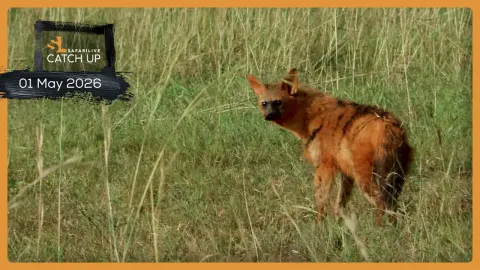
listening. And now what she's doing, she's trying to see. She might or she's hoping for a response from a male. Now, how long she's going to be calling like this? Well, it's already the third day she's calling. And if there is a male that's going to come into this area, say, for instance, if it's not, she will follow him. She's going to be kind of instigating uh the population. She's going to be the one that's really get in there. We are here with a hina that was kind of chasing a small herd of impalas, the haram and the male. And the hina does seem to be very focused. Maybe today could be a day for the hina to try hunt. Hyers are very good at hunting also. They are not fast,
but they are very good at long-d distanceance running. So, they can chase animals until the animal gets tired and kind of gives out. And the hina is right there to start eating alive. And looks like the hina is now walking towards um passing some topies and heading in the direction. We saw some impalas with a male who is missing one horn. I'll call him the unicorn impala. And honestly, he's done a good job if he's able to keep the whole haram with just one horn. Janine, yes, it is very gruesome. It's not for uh everyone to watch. Sometimes like I don't know if I would be able to watch it either, but it is uh yeah, very gruesome. These guys are very greedy.
Eating fast as possible. They're smart and like I can respect them in my own way in their different ways but the whole part of eating animals alive that's a big one and that's a big thing hiners do. So it is actually walking towards those impalas. The impalas obviously they can see him or her. The hina is very confident honestly. On Tuesday morning, Mickey and Kerat spent time with the Tracker Academy getting a glimpse into their training. And on the agenda, tracking lions. Good morning. We are here with Tracker Academy and we're hoping to go find some line tracks to work with this morning and see them in action.
It was a morning well spent and the efforts were rewarded in the best way possible. Here we go. We got nice static wild dog. They can hear the trying to call the others. They're going. This one's heading into this thicker stuff. You know, Jerry, I think they can hunt anywhere. Um, I mean, I think they often hunt through these thick stuff. And I think particularly these dogs here, they're pretty used to hunting through this thick stuff. They often spend time on the mountains. So, I think to answer your question here, they don't really mind. They'll take what they can get. I just I do think the open plains is normally where
they can see the animals better. But yeah, no, wild dogs are not fussy. I haven't seen such a kind of a scene in a long time. We got zebras, els, tppies, gazels, buffaloos. BR you saying this is magnificent. Now you'll be surprised the certain planes game we call resident when the big hards the big masses of migration leave for Tanzania they tend to remain around either they can cope or they have been or they'll say once beaten twice shy they've been through that experiences a few times but what would happen is uh this is just I would say snippets of what we would expect to see once the
migration comes what you're seeing array would be seeing this like 100 times. 100 times without any exaggeration. This is one of my not my fav not my favorite but one of I think one of the coolest looking plants. Now it has lost uh a lot of leaves and I'm not too sure if it's because it's a bit sick. um if there's maybe something there's a lot of lyken growing on this particular bush which is not usually the case but this is what we call the cra spiketh thorn now a cra is a small little it's a Africans word for like a little paddock or a little pen um and basically what we keep in crawls in South Africa are sheep goats cows And main reason um to having them in these particular areas is to keep them
away from danger. Um but the reason why they call it crawl spikethorn is because it used to be basically um kind of planted around the outskirts of um the outskirts of the these uh these crawls. Um and obviously I mean the sheep are protected. the sheep's not going to walk through it. Um, and uh, you know, leopard's definitely not going to try and fight the way cuz obviously they kill the animal, it makes noise. Um, but then, you know, it's got to try and get out. And this is a very dangerous uh, thing to do. David caught up with three of the tea boys taking a boy's morning out while Kong Goi showed us exactly how to do relaxation, taking a dip in what can only be
described as a marsh jacuzzi. Kio aka Kyongi and just to cool himself off has gone inside the laga. This is not the bilshakalaga. We usually call this laga here the grill laga. So either he's enjoying the waterfalls, he's enjoying the water, you know on his feet. I'm trying to imagine butana is basically to cool off because the cars they got it's out in the sun. They cannot afford, they cannot make an error of leaving these kakas here because there's still some good chunk left and they have to do anything they can to cool off and one of the ways you know of doing that is getting into water and Hana that's what exactly Kong goi is doing maybe he got hotter than the others because all the others are not getting in the
But what's happening is around where the kaka is there's some little kind of swamp and I'm sure it's wet and biting down they are cooling themselves. Now this boy has come very close to our vehicle and taking advantage of the shade from the vehicle. We'll always try and do the very best we can to dis encourage that. But you see when a vehicle comes to you then there's a difference of how you handle that unlike a guide driving to where the vehicle is. Remember earlier I told you uh this particular coalition of the T boys brought down a buffalo and it's right in the open. There's no tree cover. There
isn't any tree anywhere close, which would mean they desperately need to stay in the shade because the buffalo is not finished yet. The carcass, they dragged it right inside the laga. So either just like we saw Kyongi earlier, right inside the stream trying to cool off, they'll have to struggle because the sun is flat out. Now because I was with Kongi Aliyia and Zuri with a female. This is Otipo. Now that's Kiongoi. I'm not sure what Kyoi wants to and he's joining or tip there and it's only fair I discourage this from him. With the morning chapter closed, we headed into the afternoon to see what else the bush had in store for us.
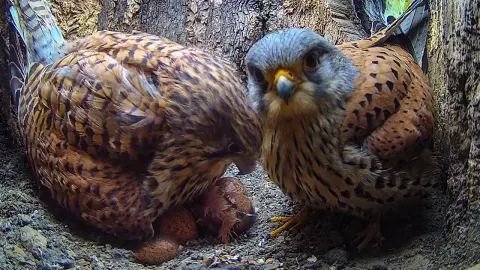
My biggest dream or my biggest joy. will see all wait until they fledge and but I they're able to fly. Now for them to fledge get the wings get the feathers become very solid to be able to coordinate their wings together that time sometimes takes about two months and going up to 3 months. So we still got a long way before these particular chikitos can be able you know to coordinate their flying to get enough strength on their muscles to lift their bodies from the ground. Hillary I only think the follow me sign for these chicks is the feet of the mother. Maybe that's the highest they can see. But Hillary, if we are very close, if you happen to be very close, I would also Hillary imagine the thumping
of the ground by this particular adult here maybe is enough sound for the cheeks to know where the mother or the father is. But mainly because they can clearly see the feet of the toes of their parents. He I would guess that's what uh they would used to see. Either way, they have very big buds. If these chicky toes put their heads up, they can see the apparent. The bush has so much to offer, including natural treatments for ailments and skin care. Amara shows us how it's done. And I wanted to show you guys the aloe vera. This is aloe vera killenis. And it is very, very good for your skin. As you can see, it's very has a lot of gel inside. And I wanted to show you that with this one, I can easily even just apply it onto my skin
because one, I was standing facing and sitting in the sun and it's really good also for after sun. I know the clouds are kind of helping, but also with helping with hydration and skin burns or any pimples, any type of acne. It's really good. It has its own antiseptic properties. I know my face is going to be shiny, but to show you the beauty of self-care also in the bush is still right there. So, this is very good. There two different types I've seen here in Kenya. There's one which doesn't have this white type of pattern. It's more dark green and it has less gel. It's very almost orange like.
Well guys, I know you've been curious about the wrong guy pride. So, we have come down to where they had the giraffe kill and there's still some lions eating at the site, but they are very much sleeping here and some are eating. So, usually this does happen. You see them sticking around even if it looks like the food is finished. So, I don't know if they will try to stick around much longer and maybe try to get away or get rid of some of uh the hyenas around. So the giraffe was big enough for them to have a lot jazz they are very healthy especially after having the big giraffe kill and it was quite impressive to see them taking down such a big animal but the giraffe that they did kill was
pregnant that's what I do here and also from the belly we saw when we got to the sighting all the other giraffes I saw in this area have walked away They've gone to the other side and I'm sure it was quite sad for them to lose a member. But our Rangai Pride is still nearby. They haven't gone far at all. The lilac breasted Aola. I've had a million sightings of these birds, but possibly this could be one of my best sightings in terms of where she is, where she's parched, the light, how she is habituated. Catch this. Catch hunt. Sally, you're wondering whether I've ever seen the cheeks of lilac breasted rollers. I mean, Sally, I have not. In general, they tend to nest uh in trees, holes of trees, and unless you're very
lucky and you go peep there, which could be a bit difficult for any guy to have seen them or unless you see them when they just fledging and coming out or when maybe they just jump out of the nest s and they fall on the ground. It's very difficult to see them. I've always wanted to see chicks of the lilac breasted rollers and chicks of the ox pickers because both of them have one commonality on where they nest way here. We wanted to show you guys how the masara just changes in an instant from hot sun, very humid and then look at that a big storm cloud. Actually, I know the camera is not able to get it, but now it looks so big. It was almost looking like a vortex at one point. You can even see the wind picking
up with the grass and how the rain is just moving in towards us. It's always nice just witnessing big storms, especially in open landscapes like this here in the Masara. You get to see it from kilometers and then you see it approaching in this way. It's always very magical. It's like a gray curtain kind of covering the whole landscape as it whips through. And it's always quite scenic and it reminds you how small we are and tiny in this world. And also how the animals they live in this environment without any shelters and they just do properly well. I myself do like stormy clouds. I'm a big fan of storms and much cooler weather. The sun is nice, but sometimes I feel a bit too hot. So, usually I do opt for something a bit more dramatic
like this. After searching and searching, nobody really expected us to find the numerous with their cubs. And what a way to find them. relaxed. And with the kill, I think they're going to be resting very nicely. Yeah, it's a perfect little spot. Nice and cool for them between the spike thorn. Oh. Oh, this one's carrying something. It's got the horns. That was interesting little maneuver there. Thank you, little boy or girl. Nice to come past there with the entire horns. Rose, it has been a while. I mean uh I haven't seen a single line for the entire stint. So and by my previous stint as well. So no that's so good that they have come back onto little Gary. Oh
this one wants to come past here. No not I want some milk Try and get some nice rich milk there from mom or from one of the mothers. Going to lie down there for us. Oh, that little one at the back. That's a very small one at the back. That must probably pale eyes. This youngster Um, Hillary, if he hasn't come closer than exactly where he's stopping now and it's almost like he's just kind of testing the boundaries and we're not responding to it, you know, we're not racing all or going towards him. So, oh, he's tangled.
The other elephant is coming now. I think she's coming to see what is going on with the young one also following behind. I think they heard this one going making all the noise. All right. Well, we got her again and she's just looking now. Look at that tail of hers. So, what's happening is that there's a rattling ciculara bird and it's busy alarm calling. So, she's like, "Yes, yes, I'm here. You can see me." And there's no surprise. You can see she's even like kind of chuffing at it. He's not happy with that bird at all. Oh my word. Yeah, this is like the worst block ever.
You can see she's sniffing and she's looking around. Definitely looking out for any form of prey again. She's still a young girl of 2 years old. So, she's still learning, you know, a few things and still catching small stuff, but also big stuff. She's been catching nice things like implorers and a nice female nihala. So, she's definitely getting there, but she still relies a lot on these small things like the squirrels and the mongoose birds. At Governor's Camp, you do not need to go far to see beautiful wildlife. And Peter shows us some of the stunning creatures right on his doorstep. We are doing some birding. Uh, we got a P kingfisher that's hover hovering around. There were about two or three of them actually.
Come on, you can do it. Uh, I'm not sure, Wendy. Um, but they look like they are definitely focused on fishing. So, I'm going to lean towards fishing for this one. That one just dropped into the water. Another one just dropped in. So, they look like they're quite active, I think. Uh yeah, this is business feeding themselves. Been quite a coolish day. Probably need to get some calories in. So, we have got them on the move in this open area. And there were actually a lot more lines than we thought. There's about five lionesses. That one looks like she's going across and one's going along the road. And the
male's coming up on our right now. He should come into the frame shortly. I'm loving this evening light on them. He's following the one that's veered off left. These lines are very pretty and especially as I said with the sun setting and this evening light and actually if we check behind this last lioness Everybody, we've got an African wild cat. I haven't seen one of these for such a long time. Don't go. Look at this. Oh my word. It's gone. And that's a wrap for today's catchup. From start to finish, the Bush delivered on some moments we won't forget anytime soon. We'll see you on the next drive. Until then, take care.